These Studies on Security contain only the results of my scientific views, research, analyses and models. In other words, they provide a SUMMARY of my MAJOR contributions to the Science of Security.
STUDY 17. BASIC CHARACTERISTICS OF THE NETWORK AS A KEY CATEGORY IN CONTEMPORARY SCIENCE OF SECURITY
Systematized are the leading properties of the Network – a fundamental scientific category and an essential phenomenon in complex social systems as we enter a qualitatively new society, which, in addition to being Globalized, Postmodern, Risk, is also Network; namely, the Network Society reflects a systemic-structural dimension of the transformation of our world – its architecture and its networking, the gradual transition from vertical to horizontal organization of systems, structures and institutions.
The following monograph of mine is devoted to the examination of the basic characteristics of the Network:
Николай Слатински. Сигурността – животът на Мрежата. София: Военно издателство, 2014.
[Nikolay Slatinski. Sigurnostta – zhivotut na Mrezhata. Sofia: Voenno iztadelstvo, 2014].
Nikolay Slatinski. Security – the Life of the Network. Sofia: Military publishing house, 2014 (in Bulgarian)
As already written in these Studies, one of the most topical and strategically important aspects of security is related to the deepening contradiction between the still widespread hierarchical organization of society and the increasing network nature of the new challenges it faces.
Networkedness as the genesis, self-organization and manifestation of the new challenges, of the sources of uncertainty, insecurity and instability, is gradually and irreversibly imposing an increasingly undoubtedly radical and undeniably dramatic CHANGE:
• change in the structure of society and in its institutional tools, with which it seeks answers to the challenges;
• change in visions and thinking, goals and planning;
• change in the structure and strategy of actors and agents in global, continental, regional and national processes;
• change in the way we relate to the world and construct the meaning of our behavior in it.
The need for this CHANGE and the urgency of its implementation put at the very center the most complex question in the passing of the civilizational, modernization and organizational baton from the receding hierarchization to the advancing networkization – about the interaction between hierarchical and network structures in the period of accelerated systemic and structural, mental and behavioral transformation. In this complex and mutually contradictory interaction, the main processes are reflected, of which we as states, peoples, societies and citizens are interested observers, direct participants and inevitable victims; what's more – we are both the causes of these processes and their consequences. In this interplay between receding hierarchical and advancing network structures are reflected all those disputed and undisputed goals that we as autonomous individuals, communal beings, socially connected persons and state-building citizens set for ourselves in our eternal quest for more security, governability, order and predictability.
Networks as a form of organization and way of behavior do not arise today, they are one of the characteristics of the world in which human existence has taken place, is taking place and will take place. The change is that from being one of the secondary characteristics they become one of the leading characteristics of our world. And such kind of changes cannot but change the arsenal of models and tools with which we study societies, cannot but change the directions and habits of our thinking about processes and trends.
Life (reality) and Science (knowledge) have always been closely intertwined, inextricably linked, going hand in hand. Life has offered Science ideas, problems, tasks for it to consider and find solutions and answers for. Science has offered Life models, points of view, alternatives for it to take into account, to comply with and to gradually adapt to, if it wants to keep up with the canons and laws of Time.
Very often that which was an object of concern and ambiguity for Life – as if through some interconnected vessels of experience and study – has become an object of thought and clarification for Science, and when Science has thought about it and clarified its essence, it it was coming back into Life as new approaches, new ideas and new behaviors. Such reciprocating process is not always a deeply conscious two-way act of generating a need for and forging a new perception. It is often seen as a fashion. It is fashionable to replace your previous views and understandings with new ones. It's fashionable not to be traditional. It's fashionable to be fashionable. It is fashionable to look at things postmodern. It is fashionable to be individualistic (even selfish). It is even fashionable to be infinitely tolerant of difference or irreconcilably intolerant of it. It is fashionable to call „network“ if not all, then at least most of the phenomena and objects. It is fashionable to talk about networking. It is fashionable to move from one network to another and thus always be part of something without ever being part of one and the same thing. That is why the „network“, besides being a leading challenge for us as individuals and as a society, is also a fashion. And fashion is often superficial, initially attractive and then fading away. When something is a fashion, when it is fashionable, it makes us not dwell on it and to perceive it in a way that is easiest for us to think about it. And this lightens it, simplifies it and gradually empties it of its inherent meaning.
The Network is a fashion, it is fashionable and modern, even more fashionable than modern. Fashion is definitely a problem, but it's not too fatal. If it is about something serious and significant, in which we are destined to be, to be present permanently and for a long time, and from the point of view of the shortness of human life – endlessly and forever, then when its fashion evaporates or passes into commonplace, it will not suffered, it will remain, it will still somehow continue.
We will say explicitly: we do not see the Network as something only technological, i.e. as a means, as a tool, as an auxiliary resource. For us, the Network is, of course, also something technological, i.e. the Network is also a means, a tool, an auxiliary resource, but it is much more than that. For us, the Network is above all:
ARCHETYPE, PATTERN, AUTOPOIESIS, ENVIRONMENT and METAPHOR.
Explanation:
Archetype (from Greek: model, example; beginning; image) – a model of an object, person or way of behaving; prototype, original; an original model, type, plot, set at the foundation of myth, folklore, culture and passed down from generation to generation.
Pattern – a regular idea, image, occurring in nature and human activity.
Autopoiesis (from ancient Greek: self; creation, production) – self-construction, self-reproduction of systems, living beings, man. Its main characteristic is that the organizing unit produces (gives birth) itself as a result, without having a division of producer and product, i.e. it is both producer and product.
Note. Clarifications for which no source is explicitly indicated are based on texts and definitions for them in Wikipedia.
NETWORK AS ARCHETYPE
The Network as a mental construct – both an idea of and a reflection of reality – has been constantly present in the collective consciousness. It was perceived as a basic condition for the horizontal connection (binding) of the community and as a mandatory prerequisite for the individual's belonging to this community. At the same time, the name for a network as a sign, as a designation for a form and the formation of a social structure is precisely „net“ – one of the means for catching fish and for hunting wild animals, densely woven from threads, cords or ropes tied with knots.
We can argue that there exists an archetype „Network“, or at least that the collective symbol (image) „Network“ contains a number of essential archetypal properties, i.e. it is an archetypal collective symbol, or to put it more briefly – an archetypal bearer [1]. Moreover, in its everyday, objective life, the concept of „network“ has a very close, unambiguous and synonymous semantic connection with the archetype (the archetypal collective symbol) „Network“ [2].
Explanation:
Semantics (from ancient Greek: significant, denoting; signifying, indicating; sign) – meaning side, meaning of language, of linguistic units, part of linguistics that studies the meaning of linguistic units. Semantic – relating to the meaning of words.
Whether as a completearchetype (which we think it is), or as an archetypal bearer (the milder claim – that it possesses a number of characteristic properties of an archetype), the collective image „Network“ is an archetype/archetypal symbol of connectedness through inherited or voluntary (rather than imposed with coercion) choice between people, i.e. of connecting horizontally – with kinship, friendship, ethnic, religious, cultural, professional or other relationships that reflect and give meaning to values, sustenance and leisure activities.
The archetypal essence of the collective symbol „Network“ means that it is a concept of a completely different kind – philosophical, conceptual, systemic, a part of the community identity, a fundamental condition for the existence of the community. A group of people becomes a community only when a culture of horizontal connection is built in it, i.e. when in the collective consciousness, which is much more than the sum of the individual consciousnesses of the individuals composing the group, the seeds of networking are sown, when the horizontal developing and spreading network of connections and affiliations begins to be woven. A community can be governed, disciplined and consolidated by vertical coercion (structural and symbolic coercion), but it can only be united, consolidated and solidarized by being connected horizontally (i.e. by networking). This is why it is so important to realize the archetypal essence of the concept of „Network“. Only by realizing this essence can one realize in depth that the network is much more than a means, a tool and an auxiliary resource. It is a synthesis, system and content of the community. It is one of the most important conditions for the existence of a community.
THE NETWORK AS PATTERN
Due to attitudes and echoes from serious philosophical debates about the relationship between Form and Content, and even more so – as traces in our minds from the constant, decades-long, instillation in it of the „only true“ Marxist-Leninist philosophy, the concept we are used to and which Bulgarian authors prefer is „Form“. It is believed that „Pattern“, like English, i.e. western equivalent of „Form“, is used only in the spirit of the tendency to replace established names in our country with their western equivalents.
Therefore, a certain, albeit simplified, explanation is required for the understanding of and the connection between the philosophical concepts of Form and Content according to dialectical materialism.
Explanation:
Form (from Latin and Greek: appearance, external outline) – appearance, external idea of the structure, purpose, functions and functioning; visibility, manifestation of the essence of an object or phenomenon.
Content – a set of essential and distinctive features; properties and relationships of the elements, processes, relations forming a given object or phenomenon.
The relations between Form and Content reflect in a complex the contradictions and dependencies between appearance and substance, i.e. between the external image and the internal essence of a given object (or phenomenon), between statics and dynamics, between the permanent and the variable, between the organization and the structure, between the intention and its implementation.
The FORM is perceived as the essence of the subject (or phenomenon), as an identifying, inseparable characteristic, giving a clear idea of „the spatial arrangement of the elements of living bodies, their external and internal structure, their morphology“ [3].
The FORM is external and internal.
• The external form is a part of the form, it is the image, the outline, the sensory perceptibility of the object (or phenomenon) in reality, its way of existence, its external manifestation, or in the words of the Russian scientist Alexey Mamzin (1928): „the external structure of the bodies and the spatial connections between the elements of the living body“ [4].
• The internal form is the structure, i.e. the static dimension and the organization, i.e. the dynamic dimension of the essence, the model by which the constituent parts and elements are connected and communicate, or again according to Alexey Mamzin: „the organization of bodies, characterizing the internal connections of the living organism, the exchange of substances, i.e. the qualitative determinations of the living body, expressed in the qualitative features of the movement of matter and their manifestation“ [5].
Explanation:
Morphology (from Greek: form; word, science) – science of the analysis of the form and construction of a given type of objects by studying their constituent parts.
The CONTENT is the set of elements, parts and processes forming the given object (or phenomenon), its distinguishing features, qualities or abilities, as well as the interactions between them or with analogous elements, parts and processes of other objects (or phenomena).
The CONTENT is static and dynamic.
• The static content encompasses the specific constituents of the subject (or phenomenon), with their specific characteristics and properties.
• The dynamic content encompasses the system relations and interactions of these constituents among themselves – the internal interactions, i.e. the internal dimension of interactions, or interactions with constituents of other objects (or phenomena) – external interactions, i.e. the external dimension of interactions.
The relationship between the FORM and the CONTENT is characterized by a unity of opposites – they are two aspects of the same thing that interpret each other, interact and can even reach a transition from one to the other: the Form to pass into the Content and the Content into the Form. But this unity is relative, conditioned by many external and internal factors. As a rule in it, the Content is the more mobile, dynamic essence of the whole (changeability), and the Form represents its stable interrelationships (constancy).
The „struggle“ between the Content seeking to develop and the Form seeking to preserve may lead to a situation where the emerging gradual discrepancy between them exhausts its ability to exist any longer and this may lead either to the rejection of the old and the emergence of a new Form, adequate to the developing Content, or vice versa – to the rejection of the old and the emergence of a new Content corresponding to the preserved Form [6].
When the concept of PATTERN is used in the theory and practice of network structures, it means, not so much and not only, that an attempt is made to replace the concept of FORM, loaded with dialectical materialism. Moreover, the philosophical reflection on the relationship between Form and Content is much more ancient and is in the sources, in the foundations of philosophy. This insightful reflection (including the understanding of the concept of „eidos“) occupied the thought of the ancient Greek philosophers even before the great sage Socrates (469 – 399), as well as the no less great thinkers of the ancient era, Plato (c. 427 BC – 347 BC) and Aristotle (c. 384 BC – 322).
Explanation:
Dialectical materialism – a direction in philosophy that combines materialism and dialectics; an understanding according to which matter is primary and consciousness is secondary, development is continuous, taking place according to the laws of dialectics. Matter is the world that exists outside of consciousness. Consciousness is a reflection of matter in the human head. The movement and development of the world is primarily understood as self-movement.
Eidos (from Greek: form, view, appearance, image) – a term in ancient philosophy, originally denoting the „visible“, what is seen, but gradually acquired a deeper meaning – „the concrete manifestation of the abstract“, „material designation in thought“; in the general sense – a way of organization and/or of the being of the object.
The pattern related to networkedness, to networked structures can be seen as primarily intellectual, not primarily sensory derived, a concept that is spiritually, mentally, intellectually related to Kant's „thing-in-itself“ [6].
The German philosopher Immanuel Kant (1724 – 1804) divided knowledge as the result of sensibility (from sense perception) and from thinking (through the categories of reason and the ideas of reason). Accordingly, the things that exist are also divided into two types:
• things in themselves, or noumena, which are unknowable, inaccessible to human senses, i.e. one knows nothing of them; and
• phenomena, that are knowable, i.e. what man perceives, of which the world as we know it consists [7].
Following Kant's logic, the Pattern is mainly analytically, not synthetically ascertainable. Analytic in this case is that which is true a priori and is generally valid, exists in itself and needs no experimental proof, while synthetic is that which must be deduced from experience and observation and gives known but not generally valid details of part of the object's elements and properties.
And again based on Kant's insightful reflections and conclusions, the Pattern is a priori, not a posteriori existing. Here, a priori is that which can be ascertained through reason and reasoning alone, without the need for sensory study, while a posteriori is ascertained through the sensory study of reality [8].
Explanation:
Thing in itself – it is independent of our perception, something whose essence and meaning are known only to one who can achieve knowledge through the mind with the help of reasoning, and not only through his senses and with the help of experience.
Sense perception – visual image, sensual image, contemplation, intuition; a direct (not mediated by thinking) act of knowledge, a product of sensibility.
A priori (literally „from the previous“) – knowledge obtained before experience and independently of it (knowledge a priori, a priori knowledge), i.e. knowledge that is, as it were, known in advance. This philosophical term gained importance in the theory of knowledge and logic thanks to Immanuel Kant.
A posteriori (literally „from what follows“) – knowledge obtained from experience (knowledge a posteriori, a posteriori knowledge).
The term PATTERN is used here to emphasize that when we study network theory, networkability, network structures, it is seen as a synthesis of key elements of FORM and CONTENT:
▪ From the Form is taken and studied not so much the External Form, i.e. the external constituent of the Form, but its inner constituent, the Inner Form – and that mainly what determines the organization, i.e. The dynamic dimension, namely the set of communications between the elements and components of the system.
In short, from the Form the Pattern includes the dynamic dimension of the Inner Form.
▪ From the Content is taken and studied not so much the Static Content, i.e. the static constituent, but its dynamic constituent, the Dynamic Content – and that mainly what determines the interactions, i.e. The internal dimension, namely the evolution of connections and communications between the elements and components of the system.
In short, from the Content the Pattern includes the internal dimension of the Dynamic Content.
So now we can summarize the essence of the Pattern:
The pattern includes the Dynamic Dimension of the Internal Form and the Internal Dimension of the Dynamic Content.
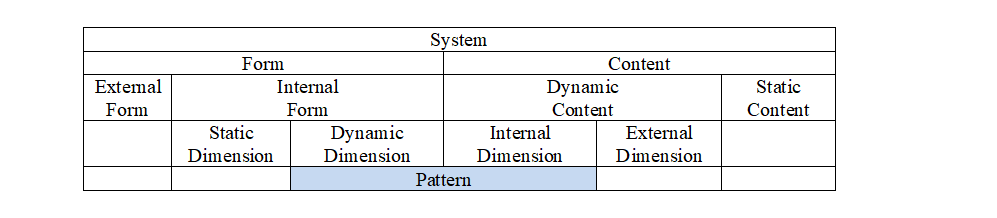
Table 1. Main characteristics of the system and determination of the meaning of the Pattern
Very often „Pattern“ is translated as „organization“, in the sense of both the way in which the elements and components of a system are organized, and the way in which they interact.
According to the Austrian and American physicist and philosopher Frittjof Capra (1939), „The pattern of organization of any system, living or nonliving, is the configuration of relationships among the system's components that determines the system's essential characteristics... That configuration of relationships that gives a system its essential characteristics is what we mean by its pattern of organization. Whereas the description of the pattern of organization involves an abstract mapping of relationships, the description of the structure involves describing the system's actual physical components” [9].
If the pattern is the organization of the network, then its structure consists of the real relations of the elements that physically make it up, and as Fritjof Capra writes: „the system's structure is the physical embodiment of its organization (i.e. of a pattern - N.Sl)“ [10]. In general, the pattern (organization) of the system does not depend on the specific properties of its components. The pattern is a network, and the elements of the particular systems may be different for each individual system [11]. Or according to the successful explanation of the Chilean scientists, biologists working in the field of intersection of biology and epistemology Humberto Maturana (1928 – 2021) and Francisco Varela (1946 – 2001) about the concept of „organization“ of the system – it is the one representing „the defining property of the system essence' a set of relationships between components, that (a) outline their form at any moment and (b) serve as the core of the „identity“ that is established despite dynamic changes over time“ [12].
Explanation:
Epistemology (from ancient Greek: knowledge, scientific knowledge, science, reliable knowledge; word, speech, teaching) – a section of philosophy, general theory of knowledge, defining the foundations, the criteria of validity of scientific knowledge in relation to both the exact sciences (mathematics and logic) and the natural and experimental sciences (physics, chemistry, biology, psychology, etc.).
„Structure“, as Humberto Maturana points out, derives from the Latin word „build“ and this allows him to give the following definition of this concept – „the current components and the current relations that must satisfy them in the constitution of the given whole unity [i.e. unified whole – N.Sl.]“. The structure does not dominate the aggregate character of the unity (the unified whole), it only defines „the space in which it is located and can be influenced“. The unity (the unified whole) can change its structure without losing its identity while maintaining its organization.
The distinction that Humberto Maturana and Francisco Varela make between organization and structure allows, as noted by the American scientist in the field of system analysis, information and theory of knowledge Randall Whittaker, to sort the descriptions of the system into abstract and concrete aspects. „The organization of the system (in the original – „the machine“) does not specify the properties of the components that realize the particular system, it only specifies the relations that the components must generate in order to construct the system as a unity (whole). In this way, the organization of the system is independent of the properties of its constituent components, which can be any, and the given system can be realized in many different ways by many different components“ [13]. Or if we continue to quote Maturana and Varela, „Organization (i.e. pattern – N.Sl.) denotes those relations that must exist among the components of a system for it to be a member of a specific class. Structure denotes the components and relations that actually constitute a particular unity and make its organization real“ [14].
The Network is both something that exists and something that evolves. It has its structure – network structure, and its dynamics – network dynamics. Structure is a manifestation of (and in this sense it is a part of) the Organization of the system, in turn Organization is a manifestation of (and in this sense it is a part of) the Dynamics of the system. Structure defines what exists, dynamics – for what it exists. And the dynamics is not an end in itself, it is based on the structure and is aimed at the implementation of the functions that give meaning to the existence of the structure, i.e. the network functions of the respective network structure realized through network dynamics. Therefore, „structure“ means the internal construction of the network entity, „dynamics“ means the evolutionary development of the network entity, and „functions“ – the realization of the purpose of the network entity (the ways of its functioning or transformation) [15].
In addition to Structure and Pattern, Frittjof Capra introduced the concept of Life Process (process of life) and defined these three concepts as the three characteristic constituents of any system. „The process of life is the activity involved in the continual embodiment of the system's pattern of organization. Thus the process criterion is the link between pattern and structure... In the case of a living organism, however, the pattern of organization is always embodied in the organism's structure, and the link between pattern and structure lies in the process of continual embodiment“ [16]. According to Capra, the triune structure is defined as follows: Pattern (the configuration of relationships that determines the system's essential characteristics); Structure (the physical embodiment of the system 's pattern of organization), Life Process (the activity involved in the continual embodiment of the system's pattern of organization) and these three interdependent elements are strongly interrelated, each of them is embodied in the other two and the three together constitute the phenomenon „life“ [17].
Frittjof Capra's three key concepts Pattern, Structure, Life Process should be merged with the above three „our“ key concepts Structure, Pattern, Functions. And only then will a complete and mutually complementary four-unit whole be obtained: Structure, Pattern, Functions, Life Process.
▪ The Structure is the permanent, static, internal structure of the system; it is that which exists, which is alive;
▪ The Pattern (organization) is the variable, the dynamic, the evolution of the internal structure of the system, it is what develops, what is vital;
▪ The Functions are the goals that the system realizes with its existence, the activities in its development, the capabilities in the realization of its purpose, the means in achieving its meaning;
▪ The life process is the way in which the system is built, developed and functions, the consistency with which it is present and participates in the spaces of exchanges and interactions and the process by which it justifies the resources and energy spent on everything related to existence, the development, the realization of the purpose and the achievement of its meaning.
It is important what the appearance of the network is, how it looks, that's why we talk about the archetype „Network“ – there is something that allows us to glimpse or imagine a system, an organization, a whole, to define it as a network. The image, the idea of the object or the phenomenon does not just reflect it, but forms thinking about it, suggests approaches to its study and use. It turns it into a symbol, a sign, an idea, an abstraction, fertilized by the logic of our perception of the world and our attitude towards the world.
Although sometimes appearances are deceiving, and it may turn out that a system that appears to be networked is not, and vice versa, that behind the appearance of something other than a networked structure lies networkedness. Far more importantly is that the Network is a Pattern, and this underscores its deep organizational and dynamic nature. Different types of networks in different dimensions of the social space (and not only in it) have similar properties and behavior, similar adaptive abilities and evolutionary priorities. They „differ from each other in their structure, but they are alike in their organization“ [18]. And this is because their pattern is common, analogous, similar, and to put it more clearly and briefly, their pattern is networked.
NETWORK AS AUTOPOIESIS
Autopoiesis is a concept of self-creation first developed and proposed in 1973 by Humberto Maturana and Francisco Varela. Autopoietic are systems that create themselves, i.e. that produce themselves, reproduce themselves; which are the product of their own development and this is one of the most important goals, if not the most important goal of their development. In such a system, the function of each of its individual components is to participate in the production or transformation of the other components, and thus the system continuously „makes itself“. It is produced by its components and in turn produces its components. Thus, it continuously reproduces its pattern and it is the product of its functioning [19].
The original definition given by Francisco Varela reads: „An autopoietic system [in the original instead of „system“ appears „machine“] is a system organized (defined as a unity [i.e. a unified whole – N.Sl.]) as a network of processes of production (transformation and destruction) of components which: (i) through their interactions and transformations continuously regenerate and realize the network of processes (relations) that produced them; and (ii) constitute it (the system) as a concrete unity in space in which they (the components) exist by specifying the topological domain of its realization as such a network“ [20].
Maturana and Varela's logic is as follows: The network pattern is the pattern of every living system. Networks, network systems are divided into non-living and living. And it is precisely living network systems, living networks that are autopoietic systems, i.e. self-creating, constantly producing themselves. Therefore, autopoiesis is the network pattern and, therefore, it is the pattern of life [21]. However, a closed circle is obtained. It starts from the fact that the network pattern is reproduced, therefore it is autopoiesis, and since it is autopoiesis, it is network [22]. In fact, this apparent contradiction can be overcome by separating the network pattern and the autopoiesis of the system. There may be systems whose pattern is network, but they are not autopoietic – for example, non-living networks („non-living“ in the understanding of Maturana and Varela, since according to them a living system is any system that carries out autopoiesis [23]). There may also be systems whose pattern is not networked, but which are autopoietic, self-generating. The network, the network structure, is a unique combination of these two fundamental properties – it has a network pattern (logically, it is a network!) and it is autopoetic (i.e. it continuously creates itself).
Maturana and Varela explicitly link the system's „aliveness“ (that the system is alive) with its autopoiesis. They call autopoiesis „the embodiment of the autonomy of life“ [24]. According to them, a system is alive if is autopoietic, and a system is autopoietic if it is alive. The criteria for a system to be alive and autopoietic are the following:
1. The system is a network of the interaction of a certain set of elements. A network structure refers to a particular pattern of organization in which each element affects each (in the sense of cause-and-effect relationships).
2. System elements are (as well) processes.
3. These are physical processes.
4. These are processes of system reproduction, i.e. the result of these processes is the constant restoration and possible modification of the system.
5. The boundary of the network is also one of the elements of the system, i.e. it is located in a network interaction with all other elements [25].
Since autopoiesis is a pattern of life, its structure changes during the development of the system, and the pattern remains unchanged. For Maturana and Varela, autopoiesis is a pattern of reason, and therefore living systems are cognitive systems, and life is a process of knowledge, and it follows that living systems are reasonable [26]. The two authors do not simply try to connect the living system and reason by considering that living systems are intelligent and intelligent systems are alive, but go even further and define cognition as „the continuous creation of the world through the process of life itself“.
Equating the system to be autopoetic and alive (which for Maturana and Varela are the same), leads to the conclusion that the system cannot preserve its pattern under all possible external influences. For every system there is a volume of invariance – a set of states in which it preserves a pattern of autopoiesis. That is why two types of external influences on the system can be considered – positive, which preserve the pattern of life, and destructive, which destroy it. Therefore, the development of autopoietic systems is equivalent to the expansion of the volume of invariance [27].
A very essential part of self-creation is self-organization – a process in which the system develops and becomes more complex, relying on its internal resources and by its own will, and not under the influence of external factors. The creator of the science of synergetics, the German physicist Hermann Hacken (1927), gave the following definition of self-organization: „Self-organization is a process of arrangement (spatial, temporal or spatio-temporal) in the open system due to the coordinated interaction of the many elements that make it up“ [28].
Explanation:
Open system – a system that continuously interacts with the external environment. In this interaction, an exchange (for example of matter, energy, information, entropy) can take place or the boundaries of the system can change.
Humberto Maturana and Francisco Varela achieved a major breakthrough in the study of complex systems through their theory of autopoiesis. Undoubtedly, autopoiesis is applicable to different types of systems operating in different target and problem spaces, but the greatest importance, at least in our opinion, autopoiesis has for networkedness, for networked structures. Networks, whether living or non-living, are autopoietic systems – they are self-creating, they are self-reproducing, they make themselves, and they are the product of their activity. The network has an autopoietic primal instinct embedded in it, it cannot exist other than to reproduce itself, to produce itself. So deep and so strong is this network primal instinct that it largely blurs the line between living and non-living systems – non-living network systems begin in their self-reproduction to behave like living ones – as if they breathe, as if they have emotions, as if they are woven of nerves and made up of organs and even whole systems of organs. Let's take the Internet or the World Wide Web (WWW). Anyone who has immersed himself in them, who has worked in them, has the feeling that this is a living network space – it has its own life, its own rhythm, its own character and its own goals, which are sometimes inscrutable. It is not for nothing that we are so easily addicted to them, they are so irresistible that already for many people they replace reality with their virtual reality and there are not a few of those who exist in real life, but live fully in their virtual world. And this is because, in addition to its other amazing and unique properties, the Network is Autopoiesis, i.e. a complex system that exists by reproducing itself, and reproduces itself in order to exist.
NETWORK AS ENVIRONMENT
From a theoretical point of view, it is fundamentally important to understand the Network as Archetype, Pattern and Autopoiesis. But from a practical point of view, with the entry into the Network society, it is particularly important to understand the Network precisely as an Environment. Because societies, all of us, social actors and agents, actors and players, are immersed in this network environment and it is unique in its properties and its manifestations. The Network is so real, perceptible, tangible, and it is also so unreal, imperceptible, intangible.
On the one hand, the Network (the Network with a capital „N“) is an environment unto itself, a meta-environment – the Network in this sense is a Meta-Network. It is both a being of its consciousness and a consciousness of its being; it is both body for her spirit and spirit for her body, it is both exterior for her interior and interior for her exterior; it is both existence for its purpose and purpose for its existence. Therefore, the Network can and should be studied by itself, in relation to itself. The Network creates its own cognitive toolkit and, learning itself it perfects this cognitive toolkit.
The network is self-sufficient as a scientific object and a cognitive toolkit – it is both an object of study and a toolkit for its study. The Network is an object of study in itself. The network, by reproducing itself, creates knowledge about itself, and by absorbing this knowledge, it reproduces itself.
This is how the life-cognitive cycle of the Network is maintained:
The Network reproduces itself The Network creates knowledge for itself The Network assimilates the knowledge created The Network uses the knowledge created The Network reproduces itself
On the other hand, however, the Network is an environment for the Whole (the a Unified whole), which exists in and through it, functions with and through it, is realized with the help of and through it – the Network in this sense is just a network (with a small „n“). It is a being of the consciousness of the Whole; it is a body for the spirit of the Whole; it is an exterior for the interior of the Whole; it is existence for the purpose of the Whole. And the Whole for which the Network was created is so immersed in, so united with, so understood through the Network that it itself becomes the Network, It is the Network. And the network makes sense only in, with and through the Whole – the Whole is the object of study, i.e. the goal of learning, while the network is only the means through which the Whole is learned. Because of the Whole, the cognitive toolkit is created, i.e. the Whole is the purpose of creating the cognitive toolkit, while the network is only the means to create that toolkit.
Therefore, the network can and must be studied only in relation to the Whole that exists in and through it, functions with and through it, is realized through and through it. The network creates a cognitive toolkit in relation to the Whole, and in studying the Whole, this cognitive toolkit is perfected.
The network as a network (with a small „n“) is only necessary for the Whole – the Whole is the scientific object and a cognitive toolkit is created for it, i.e. the Whole is both an object of study and a tool for its study. The network is only a means of learning the Whole. The network, reproducing the Whole, creates knowledge about it, and the Whole, absorbing this knowledge, transmits it to the network so that the network can reproduces it.
This is how the life-cognitive cycle of the „Whole-network“ system is maintained:
the network reproduces the Whole the network creates knowledge about the Whole the Whole assimilates the knowledge created the Whole transmits the acquired knowledge to the network the network reproduces the Whole
We have examined in detail these functional-cognitive relations the Network – the Unified whole, i.e. of the Network with the Whole that exists in and through it, functions with and through it, is realized through and because of it, because it is extremely important, including for the purposes of further analysis, to realize the Network as an Environment.
The Network is not just an environment, the Network is much more than an environment, but it is the thinking and understanding of the Network as an environment that allows finding the key to deciphering the concept of „Network“. Even if it is somewhat exaggerated or too emotional, but still, we will allow ourselves to cite the following analogy:
Just as an individual may have many roles, many hypostases, many masks and many essences, but whether and to what extent he is a person is understood by something very simple and visible to the naked eye – by the humanity he displays in relation to other people, so and the Network can have and does have different characteristics, different appearances, different manifestations, and different functions, but how it exists and is realized in its being and consciousness as a network is best understood by how it fulfills its purpose and the goals of its development precisely in its quality (and why not – in its quantity) of environment.
It is as a environment that the Network has its own unique properties and identifying markers, its own affects and effects, its own standards of behavior, even its own law of propagation.
The Network is multifaceted – with a mobile, variable, uncertain and fuzzy structure; it is multifaceted – with restless, ambiguous and unfolding dynamics. The Network is both spilling and evolving in time and, as it were, outside of time. In fact, the Network is not at all a simple and easily defined scientific category, it is not an elementary and easy-to-learn practical tool. The Network can be of more than the „normal“ four dimensions – the three spatial dimensions and the fourth temporal dimension.
This is the Network – always different, never the same. It is the happening of things, but it is also the thing that happens. The Network is everywhere, it is in everything, and everything is in the Network. That is why it will not be an exaggeration if we say about the Network again almost the same as the great the great Bulgarian revolutionary Vasil Levski (1837 – 1873) said about Time:
„The Network is in us and we are in the Network; it transforms us, and we transform it.“
Explanation:
Hypostasis (from Greek: essence, meaning, basis) – literally „that which stands below, which constitutes the basis, which guarantees the existence of things“; form of manifestation, essence, image.
Affect (from Latin: mental excitement, passion) – mood, both in external expression and in internal perception, degree of expression of emotions.
NETWORK AS METAPHOR
The Network is so effective and adequate, so attractive and desirable, so well received as a model and tool for studying contemporary processes in different systems, because it carries within itself an amazing metaphoricity, it has a strong metaphoricity in it, it is woven of metaphoricity, it is a metaphor and at least in our science the Network is the Metaphor.
In our research, we often resort to figurative, illustrative language to help the reader, inexperienced in scientific analogies and references to other branches of knowledge, better navigate a matter that sometimes at first glance is too complex, but actually becomes a narrative for the things of life (because narratives of security are narratives of life), and sometimes it seems overly, deceptively easy and straightforward, even though it hides many and varied intellectual layers and requires a far deeper preparation.
In this figurative, illustrative language, metaphors play an extremely important role. On the one hand, metaphors help to decipher complex matter, and on the other hand, they are an indicator of the need for more mental effort, so as not to allow sliding on the surface. That is why the American physicist Robert Shaw (1946) is so right when he says that „you don't see something until you have the right metaphor to let you perceive it“, as well as the American economist Brian Arthur (1945) who says that science „is about the creation of metaphors“ [29].
When he asked himself the question „What is a metaphor?“, the American sociologist Robert Nisbet (1913 – 1996) answered as follows: „Metaphor is a way of knowing – one of the oldest, most deeply embedded, even indispensable ways of knowing in the history of human consciousness. It is, at its simplest, a way of proceeding from the known to the unknown. It is a way of cognition in which the identifying qualities of one thing are transferred in an instantaneous, almost unconscious, flash of insight to some other thing that is, by remoteness or complexity, unknown to us… Metaphor is our means of effecting instantaneous fusion of two separated realms of experience into one illuminating, iconic, encapsulating image”. He goes on to say: „Strip from language its metaphors and we should be removing a great deal of what we „know“... Metaphor is not only the consequence of experience, it is often the prerequisite... But metaphor also belongs to philosophy and even to science. It is clear from many studies of the cognitive process generally, and particularly of creative thought, that the act of thought in its more intense phases is often inseparable from metaphor – from that intuitive, iconic, encapsulating grasp of a new entity or process” [30].
It is not for nothing that the creator of the term „metaphor“, the great Aristotle, claimed: „To become a master of metaphor is the greatest achievement of man... Metaphor is both a gift of genius and a mastery of the geometer, superbly mastering the science of proportions“ [31]. And as the remarkable German philosopher Friedrich Nietzsche (1844 – 1900) wrote: „The drive toward the formation of metaphors is the fundamental human drive, which one cannot for a single instant dispense with in thought, for one would thereby dispense with man himself“ [32].
Our language is full, even overflown with metaphors. We constantly construct different explanations of reality, recreate emotional states, explain our relationships to processes and people through metaphors. It is so when we say that we are floating on the wings of happiness, or when our heart leaps for joy, when we are in the abyss of despair. Metaphors are the bridges we build towards other people, the skirts of the mountain, being armed to the teeth, the bottom of the soul, nerves stretched like strings, the stone instead of a heart. Through metaphors, we translate some of our thoughts, states, intentions and goals, which we have formulated within ourselves through our own, personal and individual language, into the language of the other person, so that he can understand the meaning of what we say to him. Metaphors are also a tantalizing opportunity to create a new reality, or at least to suggest a new way of thinking about reality. They act as a sort of currency of exchange, rather like two currencies that two people exchange so that they can operate effectively, each in each other's cognitive spaces and emotional states. In other words, metaphors have a double function: they are metaphors for reality, but they are also metaphors for themselves. Their second function is much more complicated, it is resorted to much less often – these are the metaphors for the metaphors themselves, the meta-metaphors, which describe in a meta-language the reality and actually recreate it as a meta-reality.
The network, like any metaphor, simultaneously simplifies and complicates the concept (problem field) it recreates, but both times it does so in a positive and constructive way. Simplification is the result of the concept (problem field) being compared to and reduced to something known, already understood and even made sense of. And the complication reminds us that although at first glance it is about something habitual, standard, concrete, in fact it hides many different, interesting and amazing features, signs, properties, already analyzed in similar problem fields, to which the metaphor is a bridge ( to remind, metaphor comes from the ancient Greek word „carrying over“, today more often replaced and filled with more and different scientific meaning the word „transfer“).
It is very rare to find such a suitable and useful metaphor as „Network“ in the study of modern fast-horizontalizing, fast-flattening, fast-developing, fast-creeping, creative structures that, in their high dynamics, continue to be autonomous and maintaining their boundaries. The „Network“ metaphor not only represents a key to understanding these structures, like a cipher that allows one to enter their „personal [conceptual, essential] space“, but also instantly unlocks in the mind working, generating ideas, models and tools for their studying. This metaphor inspires confidence in our cognitive powers, it removes or at least minimizes uncertainty, it generates certainty in our actions. And that makes it unique and priceless.
The social actor (agent) has many roles, manifestations, hypostases in the great Network called Life. He acts in various social fields in which he weaves connections, establishes contacts, exchanges goals, values, goods, signs, symbols. He is constantly in the Network, but he is constantly in some concrete network – local, specific, Bitian. The social actor locates himself in different social sets, i.e. fields of affiliations, presences, interactions and communications – from SUBJECT HABITAT to SUBJECT AREAL.
Explanation:
Habitat (from Latin: suitable for life, habitable, inhabited) – natural environment for life, living environment; a territory inhabited by a living being or other type of organism.
Areal (from Latin: area, square, space) – the territory inhabited by the representatives of a certain organism or group (species, genus, family, etc.) of organisms; characterized by similar living conditions.
The Subject Habitat is the INTERSECTION of all social fields in which a social actor operates. In the concept of networks and the Network, of networkedness, the Subject Habitat is the smallest network segment that is somehow present in all networks in which the social actor realizes himself.
The Subject Areal is the UNION of all social fields in which a social actor operates. In the concept of networks and the Network, of networkedness, the Social Areal is the largest network segment, in which all the networks in which the social actor realizes himself are somehow present.
In the Subject Habitat, the binding is very strong, these are the so-called by the American sociologist Mark Granovetter (1943) strong ties [33]. Accordingly, as one moves away from the Subject Habitat into the Subject Areal, the binding weakens, the ties become weak (weak ties), which does not always mean less important, as Mark Granovetter proves. The smaller the Subject Habitat, the more socially passive (asocial) the behavior of the social actor and/or the stronger he defends his own social identity. And on the contrary, the larger the Subject Areal, the more socially active the behavior of the social actor and/or the weaker he defends his own social identity (it becomes increasingly blurred).
For Fritjof Capra, the basic pattern of life is the network pattern [34]. The American scientist in the field of international relations Anne-Marie Slaughter (1958) launched in 1997 the hypothesis of the network transformation of the structure of international relations [35]. The Ukrainian and Israeli culturologist Arkady Kireev (1949 – 2006) generally speaks not just about our network reality, but about our network civilization [36].
To think of the world as a network, to think networked, i.e. to develop network thinking means to think systemically. Moreover, beyond thinking about networks, network thinking itself is networked. The American physicist Jeffrey Chu (1924 – 2019) formulated his idea of scientific knowledge as a network of concepts and models in which no part is more fundamental than the other – the so-called bootstrap theory. According to this network philosophy, nature must be perceived and studied on the basis of its internal connectedness and cannot be reduced to fundamental entities, of the type of fundamental „bricks“ of matter, there are no fundamental constants, nor fundamental laws and equations. The material universe is seen as a dynamic network of interconnected things and events that exist because of their mutual relations and connections. No property of any part of this network is fundamental, they all derive from the properties of the other parts, and their overall coherence as relations and interactions determines the structure of the entire network [37].
When we study a system, we subject it to analysis both
the elements from which it is built and which are united in a structure – this is basically its content and it is related to a large extent to the QUANTITATIVE DIMENSION of the system;
and the organization – this is generally the form of the system (we have already discussed this topic and the relationships form-content, structure-organization), i.e. the pattern of that system, which is highly related to the QUALITATIVE DIMENSION of the system.
The elements of the system can be measured, calculated, weighed, while the pattern cannot. It must be depicted, drawn as a model, as a configuration, as interconnections and channels of communication. In principle, the elements can also exist independently, at least the system can be divided into parts, while the pattern exists only as a pattern – if it falls apart, the system loses its systemic properties and ceases to exist as a system. That is why the study of systems begins first of all with the study of their patterns.
However, if each system had a unique pattern, then it would have to be studied separately and without connection to the other systems, it would not be possible to transfer knowledge obtained in the analysis of one system to the analysis of another system. That's why Fritjof Capra, together with a number of other scientists, asks the question: „Is there a common pattern that can be found in all living systems?“. And his answer is that such a general pattern exists, it is the network pattern, the basic pattern of life: living systems – whether they are organisms, parts of organisms, societies of organisms, superorganisms (a single organism made up of different organisms) – their constituent elements (components) are united on a network basis. Among the main characteristics of this network principle of arrangement of living systems (the network pattern) are: COMPLEXITY, NON-LINEARITY, FRACTALITY AND FEEDBACK [38].
Explanation:
Fractal (from Latin: fragmented, broken) – a mathematical object possessing the property of self-similarity, i.e. each part is similar to the set as a whole.
COMPLEXITY is a characteristic (property) of the system, determining the amount of elements, parts and subsystems that make up the system, as well as the nature of their interaction, as well as the ability of the system to acquire new properties that are not inherent to its individual structural constituents and are not manifest at the system sub-levels, but only in the system as a whole [39].
The more elements, parts and subsystems that make up the system, the more diverse, intensive and unpredictable their interaction and the more new properties the system acquires that are not inherent to its constituents and do not manifest themselves at its sub-levels, the more complex the system, the more difficult it is to study and the less possible it becomes to predict its development and behavior in time and space.
NONLINEARITY is a characteristic (property) of the system, which means that its properties change in it under the influence of the ongoing flows and exchanges with the external environment of energy, information and matter, but in such a way that their superposition, i.e. summation (2 + 2 is not necessarily 4) is not valid, which means that there is no proportional relationship between cause and effect, between the sum and the result of the interaction of the elements, between the external impact and the response of the system to it.
This means that in certain situations with equal or similar initial and boundary conditions, approximately the same or similar characteristics of the external environment, the system can have different reactions, different behaviors, in other words, it can make different choices. Such situations of increased instability and/or strong disequilibrium and therefore of possible different choices are called bifurcation points. At a bifurcation point, it is possible that either the old structure of the system breaks down, i.e. „disorder out of chaos“ or a new stable structure to emerge, i.e. „order out of chaos“ [40], and what this new structure will be depends on the interaction and influence of many random factors.
That is why nonlinearity reflects the idea of multivariate behavior of systems, societies and the world, of alternative ways of their development or evolution [41], of the possibility of choice even in the most dramatic situations when it seems that there is no choice.
Non-linearity is counter-intuitive, it contradicts normal logic and common sense at first (and second) glance, but amazing and unexpected phenomena are associated with it, it radically changes our thinking and ideas. Previously, non-linearity was considered and viewed as a particular, extreme case, as a lack of logic, even as anti-logic. Now more and more nonlinearity comes to the fore, it turns out to be a leading characteristic of systems, and linearity is its rare, conditional, first approximation, linearity is more the exception than the rule – just as nonlinearity is the rule, nonlinearity is the universal, fundamental and in fact, one of the main properties of nature and the world [42].
FRACTALITY is a characteristic (property) of the system, reflecting the continuously reproduced and maintained self-similarity during the development of the system in time and space. A system is (а) fractal when each structural level that makes it up (i.e. a subsystem, including the basic system elements) is similar to the whole system. Fractality is a characteristic of a number of types and kinds of systems in non-living and living matter, including social.
The Russian biologist Alexander Oleskin (1959) wrote: „The network is laced and consists of cells (nuclei). This is a fractal structure, or at least tends to one as the number of cells increases. Many fractal objects are distinguished by interpenetration of the internal (belonging to the system) and the external (extra-systemic). Fractal objects are holographic: they have the property of „self-similarity“, thanks to which a small part of the structure is like a miniature copy of the whole object. Each section of the network carries the structural and functional characteristics of the whole“ [43].
Explanation:
Holography (from ancient Greek: complete and write) – a method of obtaining a three-dimensional image by illuminating the object with a laser and secondary illumination of the specially processed photo negative with such rays.
FEEDBACK is a characteristic (property) of the system, when not only the cause affects the effect generated by it, but also the effect affects the cause that generated it. In feedback, an impact leads to an outcome that affects that impact, which in turn affects the outcome, and the change can be in either direction. In negative (suppressive) feedback, the effect reduces („extinguishes“) the cause and the system behaves close to its stable, equilibrium state, homeostasis. In positive (reinforcing) feedback, the effect magnifies („ignites“) the cause and the system unfolds, self-excites and self-stimulates, constantly moving away from its stable equilibrium position. Feedback is sometimes called „Prigogyne dependence“ and the logic on which the feedback system is based is called „Prigogyne logic“.
Explanation:
Ilya Prigozhin (1917 – 2003) – a prominent Belgian physiochemist of Russian origin.
„Prigogin's logic“ means a dependence between the cause and the effect, in which they influence each other, periodically, dynamically and unpredictably exchange their places and are so intertwined that very often the effect affects the cause that gave rise to it and to which it is a function at the given time.
In mathematical approaches, networks are seen as systems of elements whose structure is woven primarily of horizontal connections and channels of communication, while vertically they are loosely structured – with at most 2 or 3 levels. The study of networks, the specifics of their structure and their reproduction in time and space, is done mainly by means of higher mathematics and physics. This allows not only to achieve a high degree of abstraction, rising above the concrete building blocks and functions inherent to the individual network, but also to obtain general, invariant formulas and conclusions. Here the structure (network) is the leading one, and what it is made of, what are the nodes in essence and their inherent qualities, and what are the nature of the connections is of secondary importance, little or even sometimes no attention is paid to it.
Sociologists, social researchers, for their part, tend to be primarily interested in what social objects the nodes are and what social dynamics are embedded in the edges connecting them, i.e. connections. Networks are seen as large (or relatively large) communities of people linked by a common culture, common goals, and a common attitude to the world or to a particular problem. In parallel with this, their very connection, called „network“, is considered – as a cause, as an ideology, as an identity.
It is identity that is the specificity that mathematical models fail to „capture“ effectively. But in order to make sense of a network and understand its properties, it is necessary to understand to a not small, but perhaps to a key extent, the identity that binds it and its influence on the social dynamics of the network [44], because the identity, the community of views, the principles, the ideology, on the basis of which the participants in the network are „glued together“, influence its structure. On the other hand, sociologists underestimate the essence of the network structure, it is tacitly assumed that the important thing is the network (the resemblance or the „resemblance“ of a network), and what structural laws the functioning of the structure as such is subject to – this has a relatively weak influence on the character of human and group relations in the network.
Until recently, mathematicians and sociologists conducted their research on networks relatively independently of each other, so sometimes the results of one were not known to the others, and sometimes they rediscovered with their scientific apparatus the phenomena and properties of network structures already established by their colleagues. It could not be otherwise, since the two groups of scientists focused their research in different places.
In mathematical models and approaches, the main thing was the structure of the system and its dynamics, while the agents (vertices) and their relationships (edges) were, conventionally speaking, reduced to nodes and edges, i.e. depersonalized, deidentified, deprived of identity. Therefore, in mathematical models and approaches, two networks are different if their structures are different.
In social models and approaches, the main thing was the content of the system – social agents and relationships, while the network was more of a metaphor, a mental construction, reflecting the prevailing horizontality of self-organization and the increasing possibility of communication of the social agents included in the system. Therefore, in sociological models and approaches, two networks are different if their active social agents and the nature of the connections between them are different.
It could be said that both mathematicians and sociologists study network dynamics, but the point is that these dynamics are actually of two types.
The first type of dynamics is the dynamics of development of the network structure – the emergence and termination of certain links and the joining and dropping of certain nodes, and we are far less interested in the links and nodes themselves.
This dynamic is called STRUCTURAL DYNAMICS.
The second type of dynamics is related not to the evolution of the network structure, which interests us less, but to the behavior of individuals (nodes) and the nature of their relationships between them (ties).
This dynamic is called AGENT DYNAMICS.
Therefore, the place, role, behavior and attitude of a social agent in the network is determined both by the position it has in the social structure (in sociology this is called STRUCTURE) and by its inherent preferences and characteristics (this in sociology is called AGENCY), but mostly from the interaction of these two main driving forces (STRUCTURE and ACTION) [45].
As the Polish sociologist Piotr Sztompka (1944) wrote: „The point is that neither the reality „agents“ nor the reality „structures“ exist by themselves. And there is no acceptable model of the actual interaction of these two realities – agents and structures – considered separately. Because in reality they are merged into a single world – this is the social world of man in his single agent-structural factory... Rather, the agent-structural reality in its internal, in its intrinsic unity, exists in various permutations, in various „mixtures“ of agentic and structural constituents and it is what organizes and constitutes social events“ [46].
It is difficult to take sides in the dispute about who was closer to the truth – the mathematicians or the sociologists. Yet more breakthroughs in the study of network structures have come from mathematicians. They much more emphasized the whole (holism), at the expense of the particularity (reductionism), and also tried much more to go beyond the concrete (literalism), trying to think abstractly, to capture the main, the essential, not what the eyes see (and more generally, the senses), but to go beyond the visible, tangible, touchable and sense-perceived reality and to delve into its deeply embedded and undoubtedly knowable logic.
It can be said that this is the eternal dispute (in recent centuries mainly in philosophical debates) – about the interaction between the Form and the Content. We, as it became clear, took the side of the approach that Fritjof Capra spoke of and therefore we use not the concept of „form“ but „pattern“, since the first concept is more reminiscent of the external appearance, of the „packaging“, while the second carries more the meaning of the structure, the building and construction of the internally unified and externally encompassing entity, together with the dynamics, evolution and development of this internally unified and externally encompassing entity.
It is mathematicians who mostly study patterns – network, network organization, network structure. It was therefore only a matter of time before their insights were taken up by sociologists and the increasing symbiosis of the natural and social sciences in relation to networks generated synergy. It is important to understand, as was said, that the pattern is not only the external form. It is the construction, the architecture of the system, the way in which they are „connected“ and the dynamics through which its elements interact. That is why the pattern is not only the form of interaction of these elements, and also it is not only a consequence of this interaction. By virtue of the feedback, the pattern imposes restrictions, determines the character of the interaction.
There is no doubt that the identity, culture, memory, attitudes and complexes of a society influence its organization and contribute to the imposition of a certain type of political rule, political regime. Therefore, with almost the same ideology, the same violent approaches to establishing one-party rule and a socialist system, the totalitarian societies in the various countries of the Soviet system differed from one another. The opposite is also true – political governance, the political regime, the construction of political relations, the ideology of „gluing together“ the participants in society, the imposed philosophy, the norms and restrictions set „from above“ on ideas, views, goals and interests influence identity, culture, the memory, attitudes and complexes of society and citizens, incite them to similar patterns of behavior (and survival). This linkage, the feedback effect where the effect affects the cause that produced it and becomes the cause of which the cause that produced it is the effect, means that totalitarian and authoritarian ideologies in politics, in economics, in interpersonal relations verticalize the structure, add hierarchical levels, narrow initiative and entrepreneurship, demand obedience and strict following of instructions, while democratic and more liberal ideologies horizontalize the structure, „flatten“ it and remove redundant levels in the hierarchy, give more freedom and initiative.
Authoritarianism tends to breed hierarchy, and hierarchy is tempted to reinforce itself with more authoritarianism. And when defects appear in one direction, they soon appear in the other direction, i.e. either the slight de-authoritarianization of authoritarianism begins to dehierarchize hierarchy, or the slight de-hierarchicalization of hierarchy begins to deauthoritarianize authoritarianism. The reverse is also true – stronger authoritarianism strengthens hierarchy, and stronger hierarchy stimulates authoritarianism.
Democracy tends to breed networkedness and networkedness tends to breed democracy. And again, when defects appear in one direction, they soon appear in the other, i.e. either the slight de-democratization of democratization begins to de-network networkedness, or the slight de-networking of networkedness begins to de-democratize democracy. The opposite is also true – more developed democracy stimulates networking, and more developed networking strengthens democracy.
That is why if we try to classify the societies (colored with different degrees of the red color – from dark, i.e. a large number of societies of the given type, to light, i.e. a small number of societies of the given type) by two criteria: „Democracy-Authoritarianism“ and „Networkness-Hierarchy“, as a rule today, the „clustering“ (dark red color) of individual societies is mostly in the „Democracy-Networkness“ and „Authoritarianism-Hierarchy“ cells, while it becomes increasingly difficult (pale pink color) to give examples of democratic-hierarchical and authoritarian-network societies. At the same time, it is clear that a democratic society, in which hierarchy is strengthened, begins to get sick, just as a network society, in which authoritarianism is strengthened, also begins to get sick. Along with this, an authoritarian society in which networkedness is increasing is beginning to heal, as is a hierarchical society in which democracy is increasing.

Table 2. Classification of societies, with coloring with different degrees of red color – from dark red, i.e. a large number of societies of the given type, to light red, i. a small number of societies of the given type
The influence of a pattern on the behavior of individuals is difficult to measure and can be identified with the interaction „social agents vs. social context“. This is the Power of Context, about which the English writer Malcolm Gladwell (1963) wrote: „The Power of Context says that human beings are a lot more sensitive to their environment than they may seem“ [47]. There is a wealth of research on how social agents create (make, change) the social context. At the same time, there is also a feedback loop, the social context determines (influences, shapes) the behavior of social agents.
We are far from underestimating what has been achieved in the research of the network society by social analysts, by sociologists. But we must point out that it is precisely the staring, the continuous focus on the social specificity and its contexts that for a long time prevented them from realizing that for all the strong individuality and identity of the nodes and connections in the networks they study, these networks are not incompatible and irreconcilable different from each other, and in them the structure plays a very serious and sometimes leading role, i.e. the way in which the nodes and connections are organized and therefore with the help of mathematical models and methods a number of key knowledge about networks can be extracted and understood. Nowadays, the productive and synergistic combination of mathematical and social methods of analysis has made it possible to draw extremely useful conclusions about the behavior of various networks and the actors and agents operating in them, and these conclusions represent valuable knowledge with a high degree of applicability in a variety of fields of science and the social sphere.
We live in a society that is increasingly networked. According to one scientific point of view, society is becoming networked as a consequence of the new nature of the dissemination of information, of the symbolic resources, as well as the increasing role of symbolic violence. In other words, society is what its communications are. And in the age of new communication and information technologies, whose nature is increasingly networked, society will naturally adapt to these revolutionary changes in communications. Therefore, in a world of social networks, society will be networked.
This scientific point of view is somewhat justified – society partially adapts its structures to the way in which communication is carried out. Nevertheless, we are more inclined to think that such social transformations are taking place in society, which gradually strengthen its horizontal reorientation at the expense of the vertical one, and in such a new type of society, naturally, communications flow in a different way, they are „forced“ to are networked to reflect the networked nature of society, i.e. communications are what society is. And in a networked society (in a networked society) it is natural for social networks to arise.
Perhaps much more sociologists are at work here, because it is extremely important to clarify what in society – such as politics and economy, such as social relations and communications, such as culture and worldview – is changing in order to intensify its network character so intensively? Why, at such rates, does Society produce the Network and the Network produces Society? What are these fundamental, profound transformations that reduce verticality and increase horizontality? And even something quite difficult to understand – whether in society always and under all conditions, horizontality means networking. This is the really important, complex subject, and we in these Studies are looking for bits of the possible right, true and exact answer, without pretending to come – even somewhat, even comparatively and relatively – close to it.
References:
1. Kelly, Kevin. Out of Control: The New Biology of Machines, Social Systems and the Economic World. 1994, 2008, p. 25.
2. Олескин, Александр. Сеть как метафорический образ культурной онтологии и сетевые структуры в социуме: приложимость к экологической проблематике, https://library.by/portalus/modules/philosophy/referat_readme.php?subact....
Oleskin, Aleksander. Set kak metaforicheskiy obraz kulturnoy ontologii I setevie struktury v sociume: prilozhimost k ekologicheskoy problematike, https://library.by/portalus/modules/philosophy/referat_readme.php?subact....
(Oleskin, Alexander. The network as a metaphorical image…). (in Russian)
3. Морфов, Радостин. Политическата стратегия. Велико Търново. Фабер. 2011, с. 37.
Morfov, Radostin, Politicheskaya strategia. Veliko Turnovo, Faber, 2011, s. 37.
(Morphov, Radostin. The political strategy). (in Bulgarian)
4. Morphov, Radostin. The political strategy, ibidem.
5. Morphov, Radostin. The political strategy, ibidem.
6. http://ru.wikipedia.org/wiki/%D0%A4%D0%BE%D1%80%D0%BC%D0%B0_%28%D1%84%D0%B8%D0%BB%D0%BE%D1%81%D0%BE%D1%84%D0%B8%D1%8F%29; (in Russian)
http://dic.academic.ru/dic.nsf/enc_philosophy/7576/%D0%A4%D0%9E%D0%A0%D0%9C%D0%90; (in Russian)
http://www.marxists.org/glossary/terms/c/o.htm#content. (in Russian)
6. Buchanan, Mark. Nexus: Small Worldsand the Groundbreaking Theory of Networks”. W. W. Nortonand Company. 2003, p. 10.
7. See for examplehttps://vidinsky.com/a/nkf1011.html; (in Bulgarian)
http://iph.ras.ru/elib/0604.html. (in Russian)
8. Cathcart, Thomas, Daniel Klein. Plato and a Platypus walk into a bar... Understanding Philosophy Through Jokes. New York, Abrams Image, 2007, 67 – 68.
9. Capra, Fritjof. The Web of Life. A New Scientific Understanding of Living Systems. New York: Doubleday, 1996, 158 – 159.
10. Capra, Fritjof. The Web of Life, ibid., р. 98.
11. Capra, Fritjof. The Web of Life, ibid., 97 – 99.
12. Витакер, Р. Обзор основных понятий теории автопоэзиса (наш архив).
Vitaker, R. Obzor osnovnych poniatiy avtopeezisa (our archive)
(Whitaker, R. Overview of basic concepts in theories of autopoiesis) (in Russian)
13. Whitaker, R. Overview of basic concepts…, ibidem.
14. Maturana, Humberto, Francisco J. Varela. The Tree of Knowledge. Boston: Shambhala Publications, 1987, 1992, p. 47.
15. See also Штомпка, Петр. Социология социальных изменений. М.: Аспект-Пресс, 1996, с. 19.
Shtompka, Petr. Sociologia socialnych izmeneniy. M/: Aspekt-Press, 1996, s. 19.
(Stompka, Petr. Sociology of social change) (in Russian)
16. Capra, Fritjof. The Web of Life, ibid., 159 – 160.
17. Capra, Fritjof. The Web of Life, ibid., 159 – 161.
18. Maturana, Humberto, Francisco J. Varela. The Tree of Knowledge, ibidem.
19. Capra, Fritjof. The Web of Life, ibid., 96 – 98. 47
20. http://en.wikipedia.org/wiki/Autopoiesis#cite_note-1.
21. Capra, Fritjof. The Web of Life, ibid., р. 162.
22. Capra, Fritjof. The Web of Life, ibid., 158 – 160.
23. Whitaker, R. Overview of basic concepts…, ibidem.
24. Варела, Франсиско. Автономность и аутопоэз (наш архив).
Varela, Francisco. Avtonomnost I autopoez (our archive) (in Russian)
25. http://www.philosophy-msmsu.narod.ru/Autopoesis/Obzor.htm. (in Russian)
26. Capra, Fritjof. The Web of Life, ibid., 161 – 162.
27. http://www.philosophy-msmsu.narod.ru/Autopoesis/Obzor.htm. (in Russian)
28. http://ru.wikipedia.org/wiki/%D0%A1%D0%B0%D0%BC%D0%BE%D0%BE%D1%80%D0%B3%.... (in Russian)
29. Bousquet, Antoine. The Scientific Way of Warfare. Order and Chaos on the Battlefields of Modernity. New York, Columbia University Press, 2009, р. 28.
30. Nisbet, Robert. A. Social Change and History. Aspects of the Western Theory of Development, New York: Oxford University Press, 1969, 4 – 5.
31. Арзуманян, Рачья. Кромка Хаоса. Сложное мышление и сеть: парадигма нелинейности и среда безопасности XXI века. М.: Регнум, 2012, с. 91.
Arzumanian, Rachia. Kromka haosa. Slozhnoe myshlenie I set: paradigma nelineinosti I sreda bezopasnosti XXI veka. M.: Regnum, 2012, s. 91.
(Arzumanyan, Rachya. Edge of Chaos. Complex thinking and the network: a paradigm of nonlinearities and the security environment of the XXI century). (in Russian)
32. Bousquet, Antoine. The Scientific Way of Warfare, ibid., р. 27.
33. Granovetter, Mark. The Strength of Weak Ties. // American Journal of Sociology, Vol. 78, Issue 6 (May, 1973), 1360 – 1380.
34. Capra, Fritjof. The Web of Lifeibid., p. 298.
35. Slaughter, Anne-Marie. The Real New World Order. // Foreign Affairs, Vol. 76, No. 5, September/October, 1997, 183 – 197, 183 – 186.
36. Киреев, Аркадий. Гипотеза о „сетевой цивилизации“, http://kulturolog.narod.ru/setciv.htm.
Kireev, Arkadiy. Gipoteza o “setevoy civilizacii”, http://kulturolog.narod.ru/setciv.htm.
(Kireev, Arkady. "Network Civilization" Hypothesis). (in Russian)
37. Капра, Фритьоф. Уроки мудрости. Разговоры с замечательными людьми. М.: Изд-во Трансперсонального Института, Киев: AirLand, Киев, 1996, 43 – 44.
Capra, Fritjof. Uroki mudrosti. Razgovory s zamechatelnymi liudmi. M.& Izd-vo Transpersonalnigo Instituta, Kiev: AirLand, Kiev, 1996, 43 – 44.
(Capra, Fritjof. Lessons of wisdom. Conversations with wonderful people) . (in Russian)
38. Capra Fritjof. The Web of Life, ibid., 78 – 81.
39. Вж. например: http://ru.wikipedia.org/wiki/%D0%A1%D0%BB%D0%BE%D0%B6%D0%BD%D0%B0%D1%8F_.... (in Russian)
40. See for example: Prigogine, Ilya, Isabelle Stengers , Alvin Toffler. Order Out of Chaos. Bantam, 1984.
41. Бирюков, Сергей В. Синергетика vs. Монополярность. // Русский Журнал, http://old.russ.ru/politics/20030430-bir-pr.html.
Biriukov, Sergey V. Sinergetika vs. Monopoliarnost. // Russkiy Zhurnal, http://old.russ.ru/politics/20030430-bir-pr.html.
(Biryukov, Sergey V. Synergetics vs. Monopolarity). (in Russian)
42. See for example: https://novainfo.ru/article/3772; (in Russian); https://en.wikipedia.org/wiki/Nonlinear_system; (in Russian)
https://www.sciencedirect.com/topics/engineering/nonlinear-phenomenon.
43. Oleskin, Alexander. The network as a metaphorical image…, ibidem.
44. Keller, Evelyn Fox. Revisiting Scale-Free Networks.//BioEssays, 2005, Vol. 27, Issue 10, p. 1065.
45. Watts, Duncan J. Six Degrees. The Sicence of a Connected Age. Vintage, 2004, 54 – 72.
46. Shtompka, Petr. Sociologia socialnych izmeneniy…, ibid. с. 273.
47. Gladwell Malcolm. The tipping point: how little things can make a big difference, Oxford University Press, 1994, р. 27.
07/11/2023
Brief explanation:
The texts of my Studies have been translated into English by me. They have not been read and edited by a native English speaker, nor by a professional translator. Therefore, all errors and ambiguities caused by the quality of the translation are solely mine. But I have been guided by the thought that the purpose of these Studies is to give information about my contributions to the Science of Security by presenting them in a brief exposition, and not to demonstrate excellent English, which, unfortunately, I cannot boast of.
Strategy Synergy Security
Personal site of Prof. Dr. Nikolay Slatinski for studies and analyses in the field of national and international security


About


All content on this website is published under the conditions of Creative Commons.
You may copy and distribute the materials for non-commercial purposes freely, as long as you credit the author with a link to this page and allow other people to use them in the same way, but without changing their content.
For any other use outside of the stated conditions, you must pay a royalty to the author.