These Studies on Security contain only the results of my scientific views, research, analyses and models. In other words, they provide a SUMMARY of my MAJOR contributions to the Science of Security.
STUDY 23. EVOLUTION OF UNDERSTANDING OF (ATTITUDES TOWARDS) RISKS OVER CENTURIES
The change in the attitude of society and individuals towards risks from ancient times to the present day is discussed.
The following monograph of mine is devoted to a detailed analysis of the evolution of the understanding of risks in the history of mankind:
Николай Слатински. Рискът – новото име на Сигурността. София: Изток-Запад, 2019.
[Nikolay Slatinski. Riskut – novoto ime na Sigurnostta. Sofia: Iztok-Zapad, 2019].
Nikolay Slatinski. Risk – the Name of Security. Sofia: Iztok-Zapad, 2019 (in Bulgarian)
There is no consensus among scientists regarding the origin of the word „risk“. Many of them believe that its origin cannot be reliably stated. Here are some of the assumptions made:
• Risk comes from the Arabic word risq/rizq, meaning „everything that comes from God“, „everything from which benefit is derived“, „everything necessary for life“; „soldier’s rations“ [1]; „acquisition of wealth and good fortune“ [2].
In one analysis we read [3]: „The similarity of Rizq and Risk is very obvious yet the connotations stand in opposition“. It is possible, according to this analysis, that the emergence of the word „risk“ in Europe around the 17th century is related to the presence and influence of Arab Muslims in the Mediterranean region of the continent several centuries earlier. „The word Rizq denotes God’s written profit, in which freedom in the individual’s effort to seek God’s bounty is balanced by the predetermined dividend distributed by God from that bounty. Al-Raziq is one of God’s 99 names meaning the Giver. At times of first transactions and exchanges by Muslims and Europeans merchants in the Mediterranean during the Middle Ages, the calculation of profit by the faithful Muslim merchant was based on the Rizq Principle, which meant that one could never know for sure what would be the profit at the end of the day. However, when the very word Rizq transmitted to Non-Muslims, it returned its sound but, in the absence of the Rizq Principle, the word flipped its meaning to its opposite. Risk became the calculation of the danger that could affect the calculation of profit. Similarly, Muslims used the word Rizq to justify their actions upon travelling to unknown worlds seeking God’s bounty, i.e. Rizq; while Western explorers used the word Risk in the 16th and 17th centuries as they embarked on their voyages to unknown worlds of danger. That was then, when the influence was impacted upon the Western World by the Muslim World. When conditions flipped and as the impact was reversed, Muslims are now learning the Risk Principle to calculate the dangers associated with making a profit; while forgetting to apply the Rizq Principle that calls for making the best effort to seek God’s bounty while accepting God’s dividends“.
In other words:
→ The Rizq principle is based on the system of beliefs related to God;
→ The Risk principle [in our opinion] is based on the system of beliefs associated with Man.
→ In the first case, a person trusts in the generosity of God with the hope that, figuratively speaking, it will bring him to the plus, no matter how he acts and no matter what his activity;
→ In the second case, a person evaluates probabilities, calculates risks, and it is he the one who bears the responsibility for making a profit or suffering damage.
Explanation:
Connotation – a nuance added to the underlying meaning of a word or expression; figurative meaning of the word.
Note. Clarifications for which no source is explicitly indicated are based on texts and definitions for them in Wikipedia.
Over the centuries, the word closest to the meaning of risk and to a certain extent the „parent“ of this word is the word hazard. According to one version, it comes from the Arabic language, from al-zahr – the dice. The Arabic word khatar means „to bet, or gamble“, and the word azar appeared in Spanish around 1100 AD., denoting a game of chance; then it passed through French as hasard into English, but as hazard [4].
• Risk comes from the ancient Greek words ῥιζικόν (ridsikon) – steep rock, underwater rock, and ῥίζα“ (rhīza – ridsa, rhiza) – steep rock, foot of a cliff or mountain, steep cliff to the sea; with the meaning „to sail round a cliff“ [5, 6].
• Risk comes from the Latin word resegāre – cut off, cut off sharply, with the idea of cliffs sloping steeply and even vertically to the shore [7]. And among the common people, the plebeian Latin resecum means danger [8].
A number of dictionaries – Italian, French, Spanish, German, English, etc. – also state that the origin of the word „risk“ is associated with either „danger“ or „threat“; with „dare“, „resolve“; either with „rock“ (underwater, by the sea, lake, river or sheer cut), with „reef“; or, sailing among dangers, pour the waves against the wind.
The following opinion is interesting:
„The Latin word riscum has its origin as a maritime term used to describe the circumnavigation of danger, especially barriers. In the Arabic origin, there is a clear and distinct linkage to prosperity, whereas the Latin origin shows greater focus on negative consequences. Knowing that the Arabic and Latin cultures overlapped in the Mediterranean, it is no surprise that risk has evolved in European culture to have both positive and negative connotations, especially with regard to trade and therefore business“ [9].
Thus, the word risk most likely has its roots in the classical vocabulary of seafaring and was used by sailors as a navigational term when entering unfamiliar waters or to denote the dangers of sailing too close to coastal rocks [10, 11]. We can say that in translation from these, as well as from other languages, the basis of the word risk is precisely the „message“ to carefully steer the ship near rocks [12], and also that risk begins to be associated with „decision-making“, the outcome of which is unknown and unsafe [13, 14, 15]. Since ancient times and especially in the Middle Ages, even when the word risk did not yet exist, „the concept of risk has included the word adventure or venture“. When it reached the Italian language, this word is supplemented with the phrase „to dare“ [16]. Gradually, this word began to acquire business and technological meanings, such as „to dare, to undertake, to enterprise, to hope for economic success“ [17]. Therefore, the English sociologist Anthony Giddens (1938) is right that the idea of risk was first used by Western travelers when they undertook risky endeavors in new, distant waters, traveling across the oceans and around the world. From the study of the container of geographical space, this concept enters into human usage during the transition to the study of the abode of historical time. Risk can emerge when, and only when, people face the prospect of the foreseeable (calculable) future, subject to human intervention [18].
Explanation:
Navigation – determining the position of a moving object. In the past, navigation was carried out mainly using a compass, instruments for measuring the angle to a certain star, sea or land maps.
• Risk comes from the Greek word riskos = a money chest (and risko-phylakion meant treasury). This is borrowed into the Arabic language precisely as rizq with the meaning of wealth and „a windfall, dependent on the gods and fate… In times of looting and banditry, the danger to a money chest is obvious, especially one being (voluntarily) transported“ [19].
• According to one Chinese translation, the verb to take a risk is „mao sien“ 冒险 and is represented by the hieroglyphs „mao“ 冒 (to do something in spite of some danger, to expose myself to), close to win, and „sien“ 险 (steep mountain, difficult passage ) with basic meanings dangerous, difficult road, steep descent, contempt for danger. The combination of these two hieroglyphs means I dare to do something despite the ever-present danger, which is interpreted as ignoring difficulties, I dare to do something in spite of them.
The difference between risk and danger is noted. I take a risk, knowingly put myself at risk, is expressed by the character „mao“ 冒 and can be understood as acting blindfolded, blindly, thoughtlessly, haphazardly, at random; while danger is expressed by the hieroglyph „wei“ 危, which derives from an image of a man looking from a cliff at his friend who fell from it at its foot [20].
• According to another translation, risk in the Chinese language is „funsien“ 风险 and is represented by the hieroglyphs „feng“ 风 (wind) and again „sien“ 险 (dangerous). Certainly in the modern Chinese language this is the word that corresponds to the noun „risk“. It is comparatively closer to „danger“ – „weisien“, 危险. It is considered a „wind-danger“, i.e. danger from wind, because fishermen, when they went out to sea, prayed that this particular danger would not befall them [21].
• According to the third translation, risk in Chinese language is called „weisien“ 危险 and is formed by combining two synonymous hieroglyphs, each of which has the common meaning of dangerous/danger: „wei“ 危 (danger) and „sien“ 险 (dangerous). With this meaning, danger „weisien“ can be perceived as a risk exactly to the extent that, for example, in Bulgarian and in Russian, danger and risk can be used interchangeably.
Explanation:
The author thanks the Chinese language expert Associate Professor Stefan Ivanchev for his consultations.
• In Japanese, two meanings are indicated:
1. risk, harm, damage, danger – 危害;
2. danger, risk – 危険 [22].
There is a dividing line between the names and meanings of the concept of risk in the West and in the East. In the West (i.e. Europe and the USA), risk is given a name with a high degree of specificity and clarity; risk is primarily a term. In the East (including China and Japan), risk is described with a high degree of abstraction and ambiguity; risk is presented primarily as a hieroglyph. A possible explanation for this fact is that people in the West began to get used to risk a long time ago, centuries ago, to include it in their activities, to tame it, to work with it and on it. That is why for their language this concept has become objective, concrete, convenient for modeling and manipulation. While in the East people did not tame it, did not turn it into a tool, into an instrument, did not introduce and integrate it into their lives, did not work with it or on it, they kept their distance from it, tried to catch only its contours, perceive its outlines, did not define it only in itself, but through other concepts and metaphors.
Let us now see the evolution of the perception of risk and risks throughout human history.
► FROM ANCIENT TIMES TO THE END OF THE 16TH CENTURY:
This is an extremely long period in the history of mankind – from the most ancient times to the end of pre-industrial society, i.e. to the threshold of industrial society, approximately by the end of the 16th century.
Explanation:
Pre-industrial society – a society in which the basic factor for development and above all for production was agriculture; it determined both the way of life of the people and the forms of political government, therefore another common name for it is Traditional Society.
Around 3200 BC is the time when, according to the American historian Leo Oppenheim (1904 – 1974), prediction, analysis and risk management originated in Mesopotamia. At that time, in the valley between the rivers Tigris and Euphrates, there was a group of educated people, magicians, spellcasters, healers Āšipu, whose functions included advising on „risky, uncertain or difficult decisions“. Āšipu members evaluated different aspects of the problem, identified alternative solutions and collected data on the possible outcomes of each alternative (win-loss, success-failure). The most appropriate evaluation criterion was considered to be the „signs of the gods“, which were interpreted by the priests. After completing the analysis, Āšipu members recommended the most favorable solution option to the client through a „report“ written on a clay tablet [23].
Explanation:
Mesopotamia (the land between the rivers, interfluve) – this is the name of the lands in Western Asia located between the Tigris and Euphrates rivers, in ancient times one of the cradles of human civilization.
By 2200/2000 BC in Middle Egyptian the word „sp“ is used (probably) to denote risk and has meanings such as actions, mistakes, misdeeds, atrocities, chance/luck, and dangerous work/adventure [24]. Since then, the concept, which, so to speak, is the progenitor of today’s concept of „risk“, contains elements of a person’s autonomy, independence and personal responsibility when making decisions, in contrast to the content of various concepts for „danger“, in which the role and will of the gods are decisive, and man is only a blind or at least obedient executor of their will.
Explanation:
Middle Egyptian language – it was spoken in Ancient Egypt around the period 2200/2000 – 1350 BC.
Around 2000 BC in Mesopotamia, insurance originated as one of the most ancient risk management strategies. For example, farmers in Mesopotamia managed potential risks by insuring their produce and borrowing shares of their surplus at interest rates.
Very high rates of interest, sometimes as high as 200%, were also noted among merchants transporting goods across the dangerous seas and places infested with bandits on land. In today's parlance, such interest rates could be called „high risk premiums“. The borrower often risked all his property, and sometimes his family, so the misfortune, the robbery of the cargo, the failure of the undertaken efforts would prove to be a real disaster for him. The significant and often dramatic consequences of the ventures led to a decline in the transportation of goods and cross-border trade and called for more effective risk management techniques, which undoubtedly is insurance [25].
Circa 1750 BC: The Code of Hammurabi (1758 BC) included loan contracts secured by a ship or its cargo, which contained a risk reward in case of loss of the ship or cargo [26 ].
Explanation:
The Code of Hammurabi – a collection of laws of the Babylonian king Hammurabi (c. 1793 – 1750 BC), discovered in Susa (Iran) in 1901. It is an inscription on a black basalt stele, which contains one of the most ancient texts of ancient Mesopotamia.
916 BC in the ports of the island of Rhodes in the Aegean Sea, local residents introduce the rules (basic elements) of the actual marine insurance. These rules became known as the Law of the Rhodians' Practices and formed the basis of the Rhodian Sea Law (lat. Lex Rhodia) [27].
Indeed, it can be argued with great justification that management of risk in the early Middle Ages and immediately in subsequent centuries was associated with the law of the sea, with the regulation of trade and navigation. This is why Rhodes Law already serves as perhaps the most widely used form of insurance, sharing the cost of losses between the ship owner, cargo owners and passengers [28].
1295 – 1325 (within broader boundaries 1275 – 1375): This period is associated with the beginning of the so-called Commercial Revolution.
Explanation:
The Commercial Revolution – a dramatic change in the economy of Europe at the end of the Middle Ages. It is characterized by the search for and finding of new trade routes, new household goods and luxuries (silk, spices), an increase in cities and their population, a sharp intensification of trade, the use of banks and credit, and the creation of guilds to regulate quality and price, different insurance practices and investment methods. It is believed to be a long period in European history, spanning the late 13th century to the beginning of the 18th century.
In order to respond to the urge of trade to develop and expand, Italian traders began to introduce new, much more efficient and flexible practices of financing, management, sharing, transfer of risk, as well as of insurance and new forms of insurance close to modern insurance [29]. The role of Italian cities and their entrepreneurial, commercial spirit is invaluable! The first insurance contracts were made by Italian merchants in the Middle Ages through a series of remarkable business innovations, creating powerful insurance companies on land and sea, the prototypes of modern banks. There is no doubt that the present insurance is a product of the Commercial Revolution [30].
At the end of the 15th century, in the 16th and 17th centuries, a number of prominent scientists, mainly mathematicians and mostly Italians, began to publish books and treatises devoted to the calculation of chance, of various elements of uncertainty in games (for example, with cards, dice, coins), and this is the beginning of mathematical research, risk assessment and management and, first of all, of course, risk quantification [31].
Explanation:
Quantification – a process of measuring qualitative attributes and characteristics and then reducing them to quantitative categories, i.e. qualitative characteristics are assigned numerical values.
Regardless of the first mathematical breakthroughs in the „taming“ of uncertainty, and hence from the awareness of the key elements of analysis and risk assessment, with which attitudes towards it begin to change, towards the end of the studied period, i.e. by the 1600s, risk was still considered to be determined by fate and therefore impossible to change, or by Divine Providence that could only be changed through prayer or sacrifice [32].
Explanation:
The Providence of God or Divine Providence – the rule of the world by God. The Providence of God is expressed in the incessant action of God in the macro- and microcosm of being, thus God preserves being and creations from harmful consequences, supports every good, and interrupts or corrects the evil that arises due to the moving away from it, directing it to good [33].
Of the whole galaxy of great scientists – mathematicians and philosophers (which is sometimes one and the same), we will mention here only the remarkable Italian astronomer and philosopher Galileo Galilei (1564 – 1642). In addition to his other important results in game theory and mathematical calculations, aimed at reducing uncertainty and gradually turning it into certainty, we will note that Galileo's main contribution to probability theory was the creation of the theory of measurement errors. According to him, these errors are inevitable and are divided into two groups – systematic, determined by the methods and means of measurement; and random, which change in an unpredictable way from one measurement to another [34].
It remains to clarify that in the Middle Ages, in addition to insurance, risk as a conscious and meaningful concept came to the fore in usury. Then a fair interest rate on borrowed money is considered to be the one that is accepted as compensation for the risk that the money lent may not be returned. And if a moneylender gives money at an unfair interest rate, he may even be burned at the stake! Although in fact, whether the interest rate is fair or not can only become clear in the future... This is also an indication of the origin of the word risk (from the Italian riscare – to weigh, to consider), which here means the possibility of money movement in the indefinite, assessed as full of dangers, future [35].
No wonder we talk so much about insurance here! As we will see later, in Modern Society, insurance penetrates many spheres of people's lives. And what can we say about real social insurance – about social security, which becomes the leading sign of the normality of society. Perhaps this is why the French sociologist Francois Ewald (1946) interpreted the development of the insurance society as an indicator determining the transition to modernity [36]. And he has every reason to say so – insurance, especially in the industrial era, introduces new features into the functioning of society, because it is based on the logic that misfortune happens to an individual, but payment for damage is socialized and to assess the cost of damage to groups with different social interests enter into disputes, i.e. „we are talking about replacing the moral characteristics of risk with economic benefits, which are quite accurately calculated“ [37]. By the end of the 16th century, religious and value dimensions of risk were almost completely replaced by economic motives [38], which were subject not to moral considerations, but to efficiency criteria. As the American economist Peter Bernstein (1919 – 2009) wrote: „The idea of risk management emerges only when people believe that they are to some degree free agents” [39]. As long as people are bound by religious prejudices and follow the will of God above all else, they are not ready to take one of the most important steps forward in their relationship with the world and their life in it – to perceive the idea of risk as something that can be controlled, or at least, something worth trying to manage.
So, during the period we are considering from antiquity to the end of the 16th century, risks were thought about mainly in communication with the gods, with the thought of possible retribution for human actions, i.e. risk is the danger of angering some god and him punishing you as he sees fit, with no direct connection between the deed and the punishment. That is why one must judge, „calculate“ not the probability of punishment (if the God is angry, punishment is inevitable), but its character. And since the omnipotence and arbitrariness of the gods means that whether and how certain actions are punished is determined not by men's judgment of their own actions, but by the gods' judgments of those actions, there is always the possibility that some god (if the gods of the people are many) or one's god (if the god is one) to „pronounce“, to „take a stand“, to punish a person for any action that goes beyond the scope of his traditional efforts and practices associated with humility and obedience, or that requires considerable effort, thus, a display of courage, enterprise, or determination.
With the wrath of the gods, the risks in maritime trade and for caravans passing through dangerous regions are assessed. Even then, insurance institutions and norms emerged, which were perceived as compensation for damage from unforeseen circumstances and God's punishments. This is a very interesting and exciting combination of the world of gods and the world of people, compensating here on Earth for the consequences of the wrath of the gods there in Heaven. However, there is still a lack of understanding that risks are the result of effective or ineffective human decision-making by people and that people are the main culprits of damage suffered. It is in this sense that it has been argued that in ancient times risk was not directly related to the practical activities of people, but was largely the result of people’s relationships with the gods [40].
Ancient societies, like all others after them, lived between certainty and uncertainty, which sometimes complemented each other, sometimes negated each other, and sometimes intersected in a kind of gray zone of something vague – both certain and uncertain, some specific definable uncertainty or indefinable certainty, the solution of which was aimed at:
› either to religion, which gives clear and definite interpretations, or to power, which imposes clear and definite explanations – these are the two main ways of constructing meaning in what is happening and in what has happened, which produce a clear, understandable and unquestionable certainty;
› either to experience accumulating in society as collective knowledge, or to knowledge accumulating as collective wisdom in society – these are the two main ways of constructing meaning in what is happening and in what happened, which transform uncertainty into a much higher explanatory mechanism, too complex and even almost impossible to understand, something that is impossible to understand, but it does not need to be understood, because it must be accepted as the only possible one.
And here is the exact observation of the English mathematician Florence David (1909 – 1993):
„With the advent of Christianity the concept of the random event of the pagan philosophers was finally rejected. According to St. Augustine, for example, nothing happened by chance, everything being minutely controlled by the will of God. If events appear to occur at random, that is because of the ignorance of man and not in the nature of the events. Man's true endeavour was to discover and submit himself to the Divine Will, and not, presumably, to cloud this search by looking at patterns of behaviour in aggregates of events“[41].
Explanation:
Saint Aurelius Augustine (Augustine the Blessed, Aurelius Augustinus, 354 – 430) - philosopher, theologian, one of the most significant personalities of Western Christianity.
According to the German sociologist Christoph Lau (1973), risks in this period were traditional: They were included „in the ethos of a certain group of people, which could be class or professional, and acted as an essential feature of the way of life, emphasizing the individual’s belonging to a group with a particular subculture.
Traditional risks were generally voluntary. Even in the presence of social coercion, of norms obliging people to take risks, a person could decide or not decide to take a risk. But what is important to understanding traditional risk is that failure is perceived as relatively less of a misfortune than principled risk avoidance. The latter was considered cowardice. A nobleman could refuse a duel, a doctor could refuse to help a patient...
Traditional risks are predictable for each specific case and each specific person... They are normed by society, create groups, determine belonging to them, thereby stabilizing the boundaries between groups. These functions of theirs are particularly noticeable in ritual actions, for example in duels and ceremonies. At the same time, rituals have a dual character: they are both a duty and a privilege...
Traditional risks are institutionalized and serve to achieve, although private, goals recognized by society. For example, the preservation of class and professional honor, the socialization of younger generations, and the acquisition of material wealth. These are primarily individual acts of behavior regulated by group norms, and, nevertheless, they are voluntarily conducted experiments by a person on himself, the outcome of which affects his destiny. They are predictable and limited in time” [42].
In Pre-Modern society, even more precisely – in antiquity and until the end of Pre-Industrial society (up to the threshold of Industrial society), i.e. until approximately the end of the 16th century, people live in a WORLD OF UNCERTAINTY [43].
Explanation:
Ethos – the disposition, character, or fundamental values that are specific to a particular person, community, people, culture, or movement.
THE NEXT HISTORICAL PERIOD IS CONNECTED WITH INDUSTRIAL SOCIETY, I.E. APPROXIMATELY 17TH CENTURY - 20TH CENTURY.
Explanation:
Industrial society – a society established in the process of industrialization, the development of mass production through machines and the emergence of adequate forms of labor organization and political management. Evidence of production that contained some industrialization arose at the end of the 16th and the beginning of the 17th century and developed towards the middle of the 17th century to an extent defined as the (Great) Industrial Revolution, covering the period 1750 – 1850 and making a transition from manual to machine production, from a predominantly agrarian to an industrial economy.
► 17TH CENTURY
1651, 1654: For the History of Science, the calculus of probabilities was then born – „the first attempt to bring the unpredictable under control“ [44], developed in correspondence between the remarkable French scientist and philosopher Blaise Pascal (1623 – 1662) and the French lawyer Pierre de Fermat (1601 – 1665), „the greatest mathematician of the 17th century“ [45].
Blaise Pascal and Pierre de Fermat fundamentally changed the way man perceives the world – for the first time in his history, he can make a quantitative assessment of the probability of a future event. It is finally becoming clear that Risk and Uncertainty are not one the same thing, and this is precisely what gives man a new chance – to influence his destiny. Thus, Pascal and Fermat laid the foundations of the determination of probabilities and thus took a significant step forward towards the creation of Probability Theory [46, 47]. Or as the Canadian philosopher Ian Hacking (1936 – 2023) wrote:
„It is notable that the probability that emerged so suddenly is Janus-faced. On the one side it is statistical, concerning itself with stochastic laws of chance processes. On the other side it is epistemological, dedicated to assessing reasonable degrees of belief in propositions quite devoid of statistical background“ [48].
Explanation:
Probability theory – one of the most relevant branches of mathematics from the point of view of modern security science. This is so because we live in a probabilistic world that will become more and more probabilistic; in a world in which randomness will turn into regularity, and the regularity will become more and more random. Probability theory studies precisely the pattern and frequency of random phenomena. In this sense, it becomes a key tool for achieving a better understanding of the world, for studying risks and emergency situations. Randomness is an event that cannot be predicted in advance with absolute accuracy. The probability of the occurrence of an event is determined by a numerical value located between 0, i.e. the event is absolutely impossible, and 1, i.e. the event is absolutely certain.
Janus – in ancient Roman mythology, a two-faced god, guardian of doors, gates, entrances, beginnings and endings.
Stochastic – random, the opposite of deterministic (i.e. determined, predetermined).
Epistemology – a general theory of knowledge that defines the criteria of validity and reliability of scientific knowledge.
1662: The monks of the Port-Royal monastery published a ground-breaking work on philosophy and probability theory, „Logic, or the Art of Thinking“ („La logique, ou Tart de penser“). In it, for the first time, the concept of „probability“ (probabilité) is used as it is understood today – amenable to numerical measurement [49]. The authors of the Logic of Port-Royal argue: „Fear of harm ought to be proportional not merely to the gravity of the harm, but also the probability of the event“ [50].
1687: Edward Lloyd (1648 – 1713) opened Lloyd's Coffee House, which served as the headquarters of marine insurers to provide insurance against shipping risks. In 1688, Lloyd's of London was founded and London became a center of marine insurance, and later of other areas of insurance. Lloyds to this day is still the „temple“ of marine insurance [51].
Insurance is related to probabilistic thinking – it is not only a consequence of it, it also gives rise to it. Insurance is a transaction between the insurer and the insured that shares the risk between them. And since neither wants to lose, one must therefore calculate the probability that an event will occur (and this is probabilistic thinking), but also calculate the probability that, if it does happen, the damage will be great. These are actually the two sides of probabilistic thinking. But when thinking in terms of the probability of something happening and the possible damage if it happens, it means thinking in terms of risk.
♦ SUMMARY OF THE 17TH CENTURY:
Risks in this period are associated with gambling and games of chance. Scientists develop mathematical theories to analyze chances (most notably Probability Theory). Risk is then understood as the probability of the occurrence of some event in combination with the magnitude of losses and gains [52]. More and more, punishments for erroneously taken steps do not have a religious connotation (for example, a person will suffer in hell), but they are economically determinable and the payment for them takes on financial dimensions.
The following instructive comparison illustrates how risk management has changed over the centuries, or rather, in just two centuries.
‣ In the 15th century, the navigator from Genoa (Italy) Christopher Columbus (1451 – 1506) believed that the main danger to his ships was pirates. The likelihood of an attack was high, but Columbus did not calculate it. He equipped his ships with rectangular sails of maximum area. This made them less maneuverable, but much faster. Pirate ships were very maneuverable, but their sails did not have as large an area as those of Columbus's ships, and therefore could not compare with them in speed. It was for this reason that Columbus managed to escape the pursuit of pirates.
‣ In the 17th century, the Swiss mathematician of Dutch origin Jacob Bernoulli (1655 – 1705) discovered the possibility of reducing the insurance rate (the percentage of risk that an insurance company takes on when insuring) when insuring merchant ships. Due to the lower rate, he attracted more clients, and due to the majority of clients, he could accurately calculate the probability of loss of cargo or vessel and, at a low insurance rate, make a decent profit.
Explanation:
Christopher Columbus crossed the Atlantic Ocean and reached („discovered“) America on October 12, 1492.
Jacob Bernoulli – the oldest representative of the Bernoulli mathematical dynasty (which produced 8 famous mathematicians!), including Johann Bernoulli (1667 – 1748), Nicholas Bernoulli (1687 – 1759) and Daniel Bernoulli (1700 – 1782).
One of Jacob Bernoulli's great achievements is that, in fact, he made „the first attempt to measure uncertainty – indeed, to define it – and to calculate the probability that an empirically determined number is close to a true value even when the true value is an unknown“ [53].
These are two approaches to risk assessment. They are separated by „only“ two centuries.
In the Columbus approach, risk is reduced through appropriate regulation. The regulation process is difficult, complex and slow, but the costs of its implementation (equipping with new, rectangular sails) increase linearly depending on the complexity and danger of the undertaking, and the damage from destruction (capture of ships by pirates) increases exponentially. This approach is applied to processes where the possible losses significantly exceed the costs of regulating the process. Therefore, in practice, Columbus's approach was economically justified.
In Bernoulli's approach, the process is unregulated or deliberately unregulated. This approach does not require the investment of funds and effort to transform the process or object whose destruction risk is assessed (no significant improvements are made to the ships). Here the mechanism is financial. Constant renewal is achieved as a result of the fact that in place of the destroyed process or object (hijacked or sunk ships, captured or destroyed cargo) a new, more perfect one is formed. This approach is applicable to processes where possible losses are significantly smaller than the costs of regulating the process. That is why, in practice, Biernuli's approach was also economically justified [54].
► 18TH CENTURY
In 1718, the English mathematician of French origin Abraham de Moivre (1667 – 1754) published the book „The Doctrine of Chances: a method of calculating the probabilities of events in play“, dedicated to his close friend and the great English mathematician and physicist Isaac Newton (1642 – 1727). This book is the first to explicitly define risk as the chance of losing: „The Risk of losing any sum is the reverse of Expectation; and the true measure of it is, the product of the Sum adventured multiplied by the Probability of the Loss“ [55]!
1738: In Volume V of the „Notices of the Imperial Academy of Sciences of St. Petersburg“ („Известиs Императорской Санкт-Петербургской Академии наук“) an article appeared with an interesting thesis: „The value of an item must not be based on its price, but rather on the utility it yields“. This important paper was originally presented to the Academy in 1731 under the title in Latin „Specimen Theoriae Novae de Mensura Sortis“, translated into Russian as „An Attempt on a New Theory of the Measurement of Lots“ („Опыт новой теории измерения жребия“) [56], into English „Exposition of a New Theory on the Measurement of Risk“ [57], and in Bulgarian with the same translation of the title as in English („Експозе на нова теория за измерване на риска“) [58].
The author of the article is Daniel Bernoulli. He was the first to develop a clearly formulated mathematical theory of risk. Bernoulli introduces the concept of „utility“ („usefulness“) to express the practical benefit or satisfaction of people when analyzing and making decisions [59]. He proposes to evaluate risk in terms of mathematical expectations of subjective meanings (values, benefits) of the possible outcomes, i.e. in modern terms this is expected utility. He describes utility as a psychological construct: „The price of the item is dependent only on the thing itself and is equal for everyone; the utility, however, is dependent on the particular circumstances“ [60].
In other words, a $100 profit means more to a poor person than to a rich person. If A has $1,000 and B has $100,000, and they each increase their wealth by $100, then the utility of that $100 to A will be, in conventional terms, 100 times its utility to B.
And something important: „Any increase in wealth, no matter how insignificant, will always result in an increase in utility which is inversely proportionate to the quantity of goods already possessed“ [61].
„The hypothesis that utility is inversely related to the quantity of goods previously possessed is one of the great intellectual leaps in the history of ideas. In less than one full printed page, Bernoulli converts the process of calculating probabilities into a procedure for introducing subjective considerations into decisions that have uncertain outcomes... For the first time in history Bernoulli is applying measurement to something that cannot be counted... He has acted as go-between in the wedding of intuition and measurement... Bernoulli introduces us to the risk-taker – the player who chooses how much to bet or whether to bet at all. While probability theory sets up the choices, Bernoulli defines the motivations of the person who does the choosing“ [62].
Explanation:
Utility – the ability of a given good, product or service to satisfy a person's need for it. The consumer's goal is to maximize utility. It is assumed that the ability of a good to satisfy needs, or the utility obtained from its consumption, can be measured quantitatively in units of utility – a hypothetical measure of the expression of utility [63].
1754: English clergyman and mathematician Thomas Bayes (1702 – 1761) lays the foundations for modern methods of statistical analysis. Bayes shows how the prior estimate of a probability changes when new information about it becomes known [64]. Operating on prior, already available knowledge is called „Bayesian statistics“. Bayes deals with the question of how we update previous knowledge when we receive new information. He considers the usual situation where we make an intuitive judgment about the probability of some event and try to understand how this judgment will change after the event has occurred, i.e. it all starts with how much we know and how that knowledge changes when we learn something new. The main essence of the Bayesian approach is the comparison of the posterior probability with the prior one. Revision of judgments made on the basis of old information, as a result of obtaining new information, provides the basis for the formation of a radically new worldview, which is why Bayes' conclusions are still relevant today [65].
Explanation:
A priori – knowledge obtained before experience and independently of it, i.e. knowledge that is, as it were, known in advance.
A posteriori – knowledge gained from experience.
♦ SUMMARY OF THE 18TH CENTURY:
Risks are talked about more and more often, and most importantly, they are thought of as a calculation of possible benefits and damages. One of the main reasons for this is the era following the great geographical discoveries and the rapid development of transoceanic and trans-sea trade [66], which put forward shipping insurance as a priority on the agenda of societies in their economic and commercial activities. Insurance of sea vessels carrying huge quantities of goods and the goods themselves was necessary, since the return of the ship brought great profit to the merchant, and sinking or an attack by pirates could ruin him. During this period, scientists tried to determine the cause-and-effect relationships between various types of risk behavior and health status, not least for insurance purposes.
Explanation:
The great geographical discoveries cover the period from the beginning of the 15th to the 18th century, when European ships sailed around the world in search of new trade routes.
In the 18th century, when thinking and talking about risk, the word hazard was still used. The word „risk“ will appear and begin to cover political, economic, financial, social, etc. discourses regarding insurance transactions only around 1830, and for almost 100 years these two words will exist in parallel, whereas already in the 20th century „risk“ will permanently and definitively establish itself in economic literature and business practice [67].
The 18th century is a great century in the History of human civilization! This is a century when reason and science were very much and unconditionally revered, were on a high pedestal, and the learned person, the scientist, was often considered a demigod! But one of the main reasons for this attitude towards this century is probably the effort it makes to measure uncertainty. Just think about it and it will seem like an oxymoron! Uncertainty is therefore uncertainty because it cannot be determined. And great mathematicians and philosophers, mathematician-philosophers in this century are trying, and successfully, to find ways and means, methods and tools for measuring it! In doing so, they pave the way for understanding and... taming risk...
Explanation:
Oxymoron – a combination of seemingly incompatible, opposite concepts.
► 19TH CENTURY
1812: French mathematician, astronomer and physicist Pierre-Simon Laplace (1749 – 1827) published his book „Analytic Probability Theory“ („Théorie analytique des probabilités“) – „the most influential book on probability and statistics ever written“ [68].
1816: German mathematician and physicist Carl Friedrich Gauss (1777 – 1855) discovers the distribution of measurement error – it is represented by a distribution close to normal.
Explanation:
Normal distribution or Gaussian distribution – a probability distribution law representing a continuous distribution of probabilities clustered around a mean value. It plays a very important role in various fields of knowledge. Its graph is symmetrical, bell-shaped, with a maximum in the mean value; it is known as the Gaussian Function. This model reflects regularities in phenomena under the influence of multiple random and independent causes and factors (see also Study 15).
1826: German economist Johann von Thünen (1783 – 1850) considered the nature of innovation risks in the process of entrepreneurial activity. His conclusion makes it possible to distinguish for the first time between the situation of risk and the situation of uncertainty. Innovative activity is associated with unpredictable results, i.e. it reflects conditions of uncertainty and the entrepreneur implementing it is the only contender for this unpredictable, risky income [69].
1848: English philosopher and economist John Stuart Mill (1806 – 1873) published the book „Principles of Political Economy“. In it he laid the foundations of the theory of entrepreneurial risk. Mill viewed the entrepreneur's profit as the sum of the capitalist's „wages“, the share (percentage) of the invested capital and the reward for risk. Under risk reward, Mill understands compensation for possible damages related to the risk of capital loss as a result of entrepreneurial activity [70].
1890: English economist Alfred Marshall (1842 – 1924) published the book „Principles of Economics“. In this „only book on economic theory from the 19th century, which can be recommended to students of microeconomics even at the end of the 20th century“ [71], Marshall introduced the name of the economic theory „Economics“. He considers two sets of risks: 1. „trade risks of the particular business in which they are engaged. They arise from fluctuations in the markets for their raw materials and finished goods, from unforeseen changes of fashion, from new inventions, from the incursion of new and powerful rivals into their respective neighbourhoods, and so on“; 2. personal risks, „the burden of which has to be borne by the man working with borrowed capital, and not by the other... For he who lends capital to be used by another for trade purposes, has to charge a high interest as insurance against the chances of some flaw or deficiency in the borrower's personal character or ability“ [72]. At that time, the state of economic science was such that the meaning of the term „risk“ did not differ too much from the ordinary, usual, colloquial meaning of this word – for entrepreneurs and insurers „the essence of risk – this is the fear that they felt about a certain scenario. This fear was a reflection of objective reality in which unfavorable events occurred” [73].
Explanation:
Microeconomics – a branch of economic science, of economics that studies how individual economic entities, such as households and firms, make specific decisions about the allocation of scarce resources, usually in markets where goods and services are bought and sold.
♦ SUMMARY OF THE 19TH CENTURY:
The management of risks, although often very hesitant, but increasingly often with discovery fervor, enters permanently into all dimensions of people's economic activity. Risk is not only a sign of gambling activity, but acquires elements of an investment undertaking, of calculating whether it is safe to invest money in order to make a profit [74]. Risk ceases to be simply the ability to predict developments and minimize possible damage or transfer it to other participants in the economic and/or trade chain, but becomes an internal necessity, an increasingly urgent need for the enterprising and courageous. Through trial and error, through careful analysis, or through impulsive action, people develop a risk-minimizing culture of behavior, of navigating the vicissitudes of the market and in their relationships as active agents seeking to make the best use of their abilities and to extract the maximum possible benefit from those abilities.
Scientific and experimental searches help to form a different, often as if ahead of its time, thinking about risk, about chance, about uncertainty, about the incompleteness and contradictory nature of our knowledge. This is a new culture of thinking and world perception, of action and world attitude. Otherwise, it is undoubtedly that everything is still in its infancy – as tools and technologies, as observational skills, as abilities to extract data from the ever-increasing volume of statistical information, and generally as a potential for generating models for study of hypotheses to explain the findings.
As the German sociologist Ulrich Beck (1944 – 2015) wrote, since the 19th century, statistics began to become the basis of probabilistic models that, based on the present, go beyond its limits, extrapolating it into the future, based on the trends of the past. Gradually, the linear extrapolation becomes more complex, covering more and more parameters to link individual trends into a synthetic perspective that outlines possible future developments. Still, the leading role is played by statistics, and not so much by new methods and approaches for analysis and forecasts based on its data [75].
Since the beginning of the century, the insurance business and associated statistical measurements of risk based on historical data have been developing [76]. It becomes possible to calculate the degree of insecurity and make plans for what awaits us – not only to accept it and submit to it, but to change and even conquer it.
The very idea that risk analysis and assessment can become the most important principle of insurance leads to the successful creation of various legal institutions, administrative practices, economic interests and technological improvements that are the basis for the development of modern capitalist societies, changes in social activity in societies occur, and all these processes provide a powerful incentive for entering and developing modernity [77].
This is probably why Jan Hecking identified the period between 1820 and 1840 as the time when an avalanche of numbers taken from the statistics of various human activities fell and began to influence the assessment and development of these human activities [78]. From the middle of the 19th century, statistical data on population trends became a mandatory element of the public debate about the problems and handicaps of society. The first attempts to discover statistical laws governing human behavior took place under the auspices of a moral and political project – to reduce the amount of crime, suicide, vagrancy, prostitution, disease.
If at the beginning of the 19th century, among intellectuals, the leading opinion was still that randomness had (if any!) negligible influence on the formation of social reality and it was believed that society's behavior was (pre)determined – just like physical reality – by the universal laws of nature, towards the middle of the century society looked more and more in the mirror of statistics, the enlightened strata, concerned about their fatherland, acquired a reliable understanding of the social aspects of society, which they could not deeply touch before due to their profession, and this helps them think about how to change social reality.
The flow of statistical data, new methods of their classification and analysis, probability theory and probabilistic thinking lead scientists and philosophers to understand that randomness has a strong influence on human behavior, and the order in society is the result of the influence (and) laws of randomness, chance and uncertainty. Determinism and the goddess Ananke are no longer the only explanatory mechanism. „Determinism was eroded during the nineteenth century and a space was cleared for autonomous laws of chance. The idea of human nature was displaced by a model of normal people with laws of dispersion” [79]. Determinism gives way, and is sometimes even challenged as the main culprit for failures to realize what is happening and to optimize the course of processes.
Explanation:
Ananke – ancient Greek goddess of fate, predestination, inevitability, compulsion and necessity.
Assaults against determinism also produce opposite reactions – common sense resists against the illogical triumph of chance in social affairs and seeks at least a little order, at least a little regularity, at least a little (pre)determination in the development of society, and not just blind subjection to the elements of chance. But this, as strange as it may sound, does not lead to the perception of risk as a heresy, as an evil, but opens wide the doors for the creation of a modern understanding of it. Risk does not lose from the counter-offensive of those seeking more determinism in social and natural processes, but even wins! Randomness and uncertainty are no longer seen as blind elements. There emerges, with all the birthmarks of immaturity, the understanding that complete determinism and complete randomness are only extremes, and that truth, or at least the guess about it, the probabilistic calculation of it, lies somewhere between these two extremes. Even when accumulated, our knowledge will always be incomplete. More knowledge, even more and more knowledge, will always be insufficient knowledge. More knowledge, as much knowledge as possible, does not give rise to absolute and strict knowledge and does not structure things in a crystal clear and categorically determined order – it only gives rise to an awareness of the incompleteness and contradiction of knowledge and of the vagueness and uncertainty in the structuring of things. Humanity is moving not so much toward more knowledge of certainty, but toward more awareness of uncertainty. And risk, accordingly, is not so much something primordial inherent in the world, but rather a product of the ways in which we construct our knowledge about the world, about what should remain uncertain in alternative scenarios of our coming future [80].
This is how the 19th century turned into a century which, after many delusions and illusions, finally began to realize that the more it knows, the less it knows. No, not that it knows less and less in absolute terms, but in relative terms. When little is known, the circle of knowledge is tiny, and its circumference separating knowledge from ignorance is small. The more one knows, the larger the circle of knowledge becomes, but the larger its circle separating knowledge from ignorance becomes, that is, the more one realizes how little one knows. The greater the knowledge, the greater the perception of ignorance, in the sense that the more a person realizes how much he still does not know. In the 19th century, the accumulation of knowledge led to an increase in knowledge about ignorance, and hence to the awareness of the ever-increasing uncertainty in the actions of society and the individual.
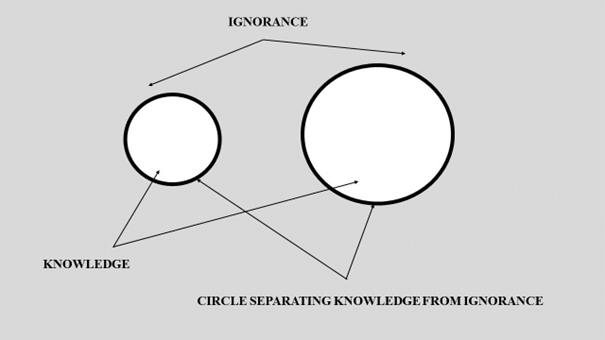
Figure 1. Relativity of Knowledge
► 20TH CENTURY
1921: English economist John Maynard Keynes (1883 – 1946) published „A Treatise on Probability“. He finds the reason for the manifestation of probability in the hypothetical nature of our knowledge about the world and argues that, in addition to the simple probabilistic connection between an event and its premises, it is necessary to take into account the degree of confidence in a given probability and confidence in the premises. Keynes defined probability as the relationship between the premises and the consequences. For him, probability reflects the rational degree of certainty that establishes a logical connection between a set of judgments (taken as initial hypotheses) and some statement (taken as a conclusion) [81]. This understanding of probability most fully reflects this concept, because without prerequisites it is impossible to draw a logical conclusion about probability [82].
„Keynes did not distinguish risk from uncertainty. He claimed that life was dominated by uncertainty, not probability. If life would obey to the laws of probability, humans would have no choices and no influence on the course of events“ [83].
Also in 1921, the American economist Frank Knight (1885 – 1972) published the book „Risk, Uncertainty, and Profit“ – this is his dissertation that left a significant mark on economics and risk management. For a little more detail on Knight's theory, see Study 7.
According to Knight, when the uncertainty is measurable (measurable uncertainty), it is a risk, and when the uncertainty is unmeasurable (unmeasurable uncertainty), it remains uncertainty [84]. This understanding has been established in the economic literature with the status of a classical understanding.
1926 – 1929: The remarkable Hungarian mathematician of Jewish origin John von Neumann (1903 – 1957) laid the foundations of Game Theory as a mathematical discipline, proving the so-called „Minimax Theorem“ (1928). He laid out his Theory of Strategic Games in a paper published in 1928. For the first time, the possibility of losses is analyzed as an integral part of risk management. For more information on Game Theory, see Study 18.
1927: German physicist, Nobel Prize winner in physics (1932) Werner Heisenberg (1901 – 1976) formulated the famous Uncertainty Principle in Quantum Mechanics, according to which it is impossible to simultaneously determine the exact location and the exact velocity (more precisely, the exact momentum) of one electron, i.e. „The more precisely we measure the location of the particle, the more imprecise the measurement of its momentum becomes“ [85]. The reverse is also true: the more accurately we measure the momentum of a particle, the more imprecise the measurement of its location becomes.
Study 14 introduces the Uncertainty Principle in Riskology, analogous to Heisenberg's famous Uncertainty Principle in Quantum Mechanics
Explanation:
Momentum in physics – a physical quantity that is the product of the mass of a body and its speed.
1944: John von Neumann and Austrian economist Oskar Morgenstern (1902 – 1977) published the book „The Theory of Games and Economic Behavior“, based on the concept of utility and incorporating risk and uncertainty into economic theory. This classic book laid the foundation for mathematical Game Theory [86]. Utility is defined as money under risk. They prove Daniel Bernoulli's thesis of expected utility as the sum of the utilities of the outcomes weighted by the probabilities of the outcomes, and propose a way to measure utility numerically. Thus, „Epistemological uncertainty was hence transformed into ontological risk, as a distribution function over known possible states of the world“ [87]. Thus, risk attitude becomes a measure of people's subjective assessment of money. Subjective expectations are much more difficult to measure, and some even consider them mystical or ridiculous [88].
Explanation:
Ontology – a branch of philosophy that studies the general foundations and principles of existence and reality, of being, its structure, categories and regularities.
1952: Just 25 years old, graduating from the University of Chicago, the American economist Harry Markowitz (1927 – 2023) published in the „Journal of Finance“, the leading academic journal of financial affairs, the article „Portfolio Selection“, which after 38 years brought him the Nobel Prize. In it, he lays the foundations of a model for the formation of the investment portfolio, aimed at the optimal distribution of assets between the various financial instruments under conditions of uncertainty based on the profitability/risk ratio. The risk for the assets in the investment portfolio is considered as the risk for the constituents of the single portfolio and not for its individual assets [89]. Markowitz proposes an optimal asset allocation and proves that there is an optimal portfolio that maximizes return and minimizes risk.
Explanation:
Portfolio – „a complete set of investment securities owned by one individual or legal entity (bank, pension fund, investment trust)“ [90].
Investment portfolio – securities that are held primarily for the purpose of sale and distribution, as a result of which an economic benefit will be realized.
A security – a written document, upon presentation of which rights are materialized – property, bondя and other. Securities are divided into fixed-income securities and variable-income securities. Bonds belong to the first, stocks to the second.
1954: American mathematician Leonard Savage (1917 – 1971) published his book „Foundations of Statistics“, in which he developed the Theory of Subjective Expected Utility, one of the branches of Bayesian statistics and applied models of Game Theory, that „combines two aspects of decision-making under conditions of uncertainty or risk. On the one hand, it is the personal utility function, and on the other, the subjective probability distribution, which is based on Bayes' theorem“ [91, 92]. According to Savage, probability is the degree of reliability of the ideal, i.e. the rational individual who, when making a decision, acts according with the axioms of the probability theory [93].
1955: American insurance professor Harold Wayne Snider (1923) proposed the term „risk management“ [94].
1961: Former American military analyst Daniel Ellsberg (1931 – 2023) published an article in the Quarterly Journal of Economics introducing the concept of Ambiguity Aversion. This means that people prefer risks with known probabilities of outcomes to risks with unknown probabilities of outcomes. „Ambiguity aversion is driven by the feeling of incompetence… [and] will be present when subjects evaluate clear and vague prospects jointly, but it will greatly diminish or disappear when they evaluate each prospect in isolation“ [95].
Explanation:
In 1971, while a fellow at the RAND Corporation, Ellsberg caused a scandal by submitting a volume to „The New York Times“ and other newspapers entitled „United States-Vietnam Relations, 1945—1967: A Study“ – the so-called „Pentagon Papers“ – the US Department of Defense's top-secret in-house study of the Vietnam War and its background, showing the government in a rather unfavorable light. For this act, the prosecution sought a maximum sentence of 115 years in prison. The defense dropped all charges.
RAND Corporation – Research And Development; international and national security and defense research and analysis think tank based in Santa Monica, California.
1964: American economist and Nobel Prize winner (1990) William Sharpe (1934) published the article „Capital Asset Prices: A Theory of Market Equilibrium Under Conditions of Risk of Risk“ in „Journal of Finance“. In this article, Sharp proposes an idea for the Capital Asset Pricing Model, CAPM [96]. CAPM is an „equilibrium model describing the relationship between systematic risk and required return on assets held in diversified portfolios“ [97].
1979: The first joint publication by Israeli psychologists Daniel Kahneman (1934) and Amos Tversky (1937 – 1996) appeared in the journal Econometrica, laying the foundation for Prospect Theory, which is extremely important in the field of risk research [98].
Late 1980s: Big banks start using the VaR (Value-at-Risk) concept.
Explanation:
VaR – a universal methodology for assessing various types of risk, including: price risk – risk of changes in the value of a given financial asset on the market; currency risk – risk related to a change in the exchange rate of the national currency against another currency; credit risk – risk arising in case of partial or complete insolvency of the borrower; liquidity risk – risk of inability to sell a given financial asset (risk of selling with huge losses).
1992: The specialist in strategic management, the American Kent Miller in a publication „A Framework for Integrated Risk Management in International Business“ in the „Journal of International Business Studies“, offers a framework for categorizing the uncertainty faced by firms operating internationally and outlines both financial and strategic responses in corporate risk management [99].
1996: American specialist in corporate finance Russell Gallagher in an article „Risk management: new phase of cost control“ in the „Harvard Business Review“ first described the profession of „risk manager“ [100].
♦ SUMMARY OF THE 20TH CENTURY:
The 20th century is a century of continuous presence of the concept of „risk“ in the activities of states and societies – in politics and military affairs, in economics and finance, in entertainment and the consumption of goods. Risk calculation is now a mandatory activity in insurance and lending, in statistics and stock market games, in acquiring shares in companies and investing in significant projects [101].
In the mid-1930s in the USSR, risk was declared a bourgeois concept and it was believed that with the development of a planned economy it would begin to die out [102].
Explanation:
Bourgeoisie - in Marxism, the bourgeoisie is understood as the ruling, exploiting class of capitalist society; it is considered the source of all ills, the curse of workers in particular and all ordinary, working people in general.
As technology develops and industrialization reaches its peak, something happens that first suggests the direction of development in terms of risks, and then begins to increasingly influence the processes of risk entry in any economic, financial and social activity, to finally serve as a solid foundation, as a base camp for climbing the next peak, namely entering the Risk Society, as Ulrich Beck once first called it.
It is no longer only the state, society and people that are a function of risks, but they themselves become producers of risks. Not only do risks set people's agendas, but people come to set risks' agendas. Man gradually acquires two amazing qualities, two key essences – he becomes both a Risk-taking being and a Risk-producing being. And today he already possesses these two essences in full, and in such a way that they, to one degree or another, but not to a small extent, overshadow his other essences as an active social subject, a creator of values and benefits, and an agent of change.
♦ SUMMARY OF THE PERIOD FROM THE 17TH TO THE 20TH CENTURY:
During this period, again according to Christoph Lau, risks are already industrial: „In the industrial age, when rationality became the main characteristic of economic and professional activity, the attitude towards risks also became more rational. Using probability theory, people begin to calculate and compare risks. This first stage of the scientific study of risk... corresponds to the emergence of insurance companies, or rather their flourishing, since they existed as early as the Middle Ages. The idea of insurance is simple: an accident, a trouble happens to an individual, and the payment for the damage is socialized. The redistribution of monetary consequences among the insured fundamentally changes the nature of the attitude towards risks. They are freed from normative ties to class subcultures and become subject to conflicts and bargaining between groups with different economic interests. As a result, a symbolic equality of such incomparable values as life, health, property is established. The very willingness to take risk begins to be perceived more rationally... A „society of universal protection“ is emerging. Consequently, risks, due to their already statistically understood nature, become unsuitable for establishing group identity. Damages suffered by a person are distributed among the entire community of insured, and not among the group to which the victim belonged on the basis of occupation or class... The principle of separating the right to compensation from the cause of the damage makes individual responsibility for specific consequences from risk into an economic-rational obligation to protect against damage and liability... We are talking about replacing the moral characteristics of risk with an economic benefit that is quite precisely calculable. Thus, the prerequisites for emotional impoverishment and objectification of risk perceptions are the individual orientation of industrial risk and its consequences, its calculability, the limited nature of possible damages, causes and consequences in time and space“ [103].
Summarizing these four centuries of early, established and late industrialism or industrial society – the 17th, 18th, 19th and 20th centuries – we can say that mainly in Western Europe, but also in the USA, there was a new understanding of natural disasters (earthquakes, floods, droughts, forest and field fires) and related emergencies (pandemic diseases and social catastrophes such as plague, famine, refugee waves). Societies, especially enterprising people and business, get used to the risks posed by emergencies, economize and desacralize them, deify them, strip them of the aura and halo, the mysticism and paranormality of God's work and God's punishment. Thus, instead of human activity being located in, within, consequent upon, and under the will of the uncontrolled and superhuman divine „extraordinary“, it comes to be perceived as occurring through, accompanying, along with, and in conjunction with the „extraordinary“. It, the „extraordinary“, although immeasurably greater and more severe in consequences, becomes „part of the game“, a condition that must always be accounted for, evaluated and included in contracts so that, then and when it occurs, compensations should be provided for and agreed upon, and damages should be measurable and shareable. In other words, people learn and learn – slowly and patiently, with pain and suffering, at the cost of many failures and disappointments – to live and undertake activities not under the control of, but together with the extraordinaryness.
Explanation:
Aura – a faint light that some people supposedly see around the human body; an atmosphere that is emitted by someone or something.
Halo – a light circle surrounding the heads of saints and angels on the icons to emphasize their sanctity.
Paranormal phenomenon – a phenomenon for which there is no scientific evidence, no scientific explanation and which is outside the boundaries of the modern scientific picture of the world.
If in ancient times and until the end of pre-industrial society (to the threshold of industrial society), i.e. approximately until the end of the 16th century, people live in the WORLD OF UNCERTAINTY, then in the industrial society, 17th - 20th centuries, people live or, as it was said, gradually, slowly and patiently learn and learned to live in a different world, a world of both uncertainty and risk, in the WORLD OF UNCERTAINTY & RISK.
► XXI CENTURY
According to Christoph Lau, during in the transition to post-industrial society and in the first phases of post-industrial society, the risks are new:
„New risks are primarily technological. The peculiarity of new risks is that they arise mainly as a result of collective decisions and actions. At the same time, in societies with a high degree of functional differentiation, the cause-and-effect relationship is constantly broken: as a rule, it is not the one who created the dangerous situation who suffers... Large-scale human intervention in natural processes (chemistry, nuclear physics, gene technologies) produces consequences, that, on the one hand, cannot be directly observed, and on the other, due to their complexity, they cannot be blamed on those who took risks...
New risks arise as a result of human activity, but for those affected by them, they remain anonymous and coercive, like natural disasters. And this paradoxical relationship between personal responsibility and anonymity is a central issue in discussions of risk.
New risks have a leveling and individualizing effect. If the dangers to health and life are anonymous, group membership loses some of its meaning. In the face of danger, all are equal, at least at first. Individualization leads to a decrease in the sense of stability and security, to the variability of social identity depending on the situation, which contributes to an increase in general, not group risk consciousness, and society as a whole becomes more and more sensitive to risk.
New risks remain undefined in many respects and, due to scientific evidence of increasingly complex cause-effect relationships, their implications are immeasurable. The harm caused to people and nature is difficult to express in money and, in general, it is difficult to realize. It is impossible to accurately indicate the group of victims, the scale and type of consequences, the time during which the risk exists or its consequences arise. Previously, the period of danger was limited to relatively specific time intervals. Now the line between everyday life and crisis is disappearing. People live in constant tension, in conditions of omnipresent and incessant danger. It is natural to assume that the consequence of such contradictory conditions of human existence will be, firstly, anomie, destabilization of norms, and secondly, a naive or cynical attitude to the global dangers that have become habitual.
Thus, new risks are characterized by the following features:
- they are collective risks of the second order, acting in a leveling and individualizing manner;
- due to the already achieved level of scientific and technological development of society, the new risks manifest themselves compellingly both for the subjects and for their objects. Therefore, new risks can provoke spontaneous processes of solidarity that go beyond the boundaries of established social groups. In fact, as a result, unstable diffuse groups arise, limited by a specific situation (time, place, event);
- they are risks with significant consequences, uncertain in all respects, which creates tension in society and an irrational attitude towards them“ [104].
Explanation:
Anomie – a social condition defined by the eradication or destruction of any moral values, standards or guidelines that people should follow. It is believed that anomie likely develops as a result of conflicting belief systems and causes a breakdown in social ties between the individual and the community.
The Australian sociologist Deborah Lupton (1963) systematized the following seven categories, which we can assign to what Christoph Lau called „new risks“:
1. Environmental risks. These are risks posed by environmental pollution, radiation, chemicals, floods, fires, dangerous road conditions, etc.
2. Lifestyle risks. These are the risks posed by consuming food and drugs, engaging in sexual activities, driving, stress, leisure time, etc.
3. Medical risks. These are risks posed by the medical care and treatment provided, such as drug therapy, surgery, childbirth, reproductive technologies, diagnostic tests, etc.;
4. Iinterpersonal risks. These are risks posed by social interaction and communications between individuals, such as intimacy, social relationships, love, sexuality, gender roles, friendship, marriage, parenting, etc.
5. Economic risks. These are risks posed by employment and unemployment, loans and credits, investments, bankruptcies, destruction of property, business failure, etc.
6. Criminal risks. These are risks posed by the possibility of the individual being a participant in or a victim of criminal activities.
7. Political risks. These are risks posed by political instability, terrorism, illegal migration and civil unrest [105].
Let's clarify something important. As for modern society, it can indeed be characterized as a post-industrial society in terms of advanced technologis, productive capabilities and competitive advantages, but this is only one dimension of its functioning when it comes to the way in which society reproduces and develops, understands itself and self-optimizes, satisfies its basic needs and regulates its conflicts, ensures its security and manages its risks. Today's society as a society, facing the problems of our time; as a complex that seeks the optimal response to these fundamentally new conditions; as a system that is fully and deeply aware of itself – is directly related to the risks it creates and the risks of which it is a function. In the hyper-dynamically developing 21st century, people live under the pressure of processes, events and circumstances that generate risks, contain risks, and pose risks. If they want to survive as a society, develop as a society and prosper as a society, people must learn to live in a world where risk has completely replaced uncertainty (insecurity, unknownness, obscurity, ambiguity) [106]. And this world is not fiction, it is not an illusion, it is not self-deception, it is not something that could possibly happen to us – it is today's world, the WORLD OF RISK. That is why today's society cannot be called anything other than Risk Society of risks, i.e. it is comprehensively and fully a Risk Society.
Explanation:
Fiction – something made up; unreality, illusion, fantasy.
World of Risk (англ.) – свят на риска.
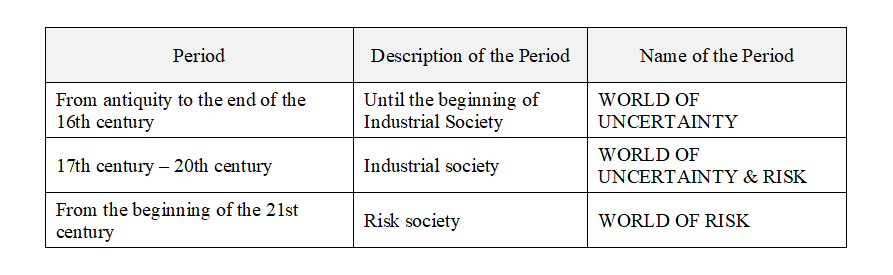
Table 1. Periodization of societies in terms of uncertainty and risk
It is necessary to consider the evolution of man in the understanding of probability. No, this evolution should not be underestimated, because it contains very important elements! By changing the attitude towards probability, a person emerges from deep pre-modernity and begins to boldly step through modernity, aiming – and quite purposefully at that – towards post-modernity. To break free from the shackles of pre-modernity, you need to think about the world and everything in it, think about space and time (yes, about time too!) as probabilistic, with alternative paths and scenarios, and to understand that there are not only two possibilities – 0 or 1, yes or no, but there are many possibilities, and their quantity is not a discrete set, i.e. with a finite number of states. It should also be understood that if something is probable, even with the slightest probability, then it is possible, and therefore very possible. Probability is the door through which the risk will come to the man. But the man will also go to the risk!
When it is realized that human knowledge is not subject to complete analysis and, moreover, it is by its very nature relative, conditions arise for the transition of man and the community of people from the realm of uncertainty that escapes control and awareness to the realm of the incompletely understood and contradictorily aware probability – to the realm of risk-related phenomena. We have outlined the stages of this transition – from the World of Uncertainty, through the World of Uncertainty and Risk, to the World of Risk.
The understanding of risk develops along with the evolution of society. It is not only an interesting and instructive consequence of this evolution, but at least to a certain extent the reverse connection, the reverse logical thread is also in effect – the evolution in the understanding of risk has led to further development of society. Thus the cause and the effect partly change their places, the effect is becoming in some sense the cause of the cause that gave rise to it. It is difficult to find a closer connection between the evolution of society and the evolution of its conceptions of its existence and development than the relationship „society – risk“. Society develops and with its development develops its concept of risk, but at the same time developing its concept of risk, society in turn also develops. This is why the scientific category of risk is so important – it looks at society like a mirror, and based on society’s understanding of risk, we can judge society itself and better understand it, and then contribute to better management of it. By managing society, we manage its risks, and by managing society's risks, we manage society itself.
In the new age, we are mastering the strategy of behavior in conditions of risk, and this allows us to no longer consider the future as the property of the capricious will of the gods, for the understanding of which we turn to religious prophets and oracles [107], but we can roll up our sleeves and get started – today! – to model our life in such a way as to obtain one of the possible futures. Thinkers, scientists, experimenters have built risk into the present and forged from it a tool for improving human life. Thanks to them, risk became the catalyst and conditio sine qua non of progress. „Like Prometheus, they defied the gods and probed the darkness in search of the light that converted the future from an enemy into an opportunity. The transformation in attitudes toward risk management unleashed by their achievements has channeled the human passion for games and wagering into economic growth, improved quality of life, and technological progress“ [108].
Explanation:
Prophet – a person called by God to announce his will to the believing people.
Oracle – among ancient peoples, is a place, object or sacred being through which a deity speaks. Oracles are usually accompanied by their soothsayers, diviners or interpreters – i.e. people who translate the divine will into human language. Often these people are also called oracles. The work of oracles is mainly concerned with predicting the future.
Conditio sine qua non (lat.) – a condition without which it is impossible; an obligatory or extremely necessary condition of something.
Prometheus – in one of the ancient Greek myths, Prometheus was severely punished by Zeus for giving fire to humans. He was chained to a rock in the Caucasus and every day an eagle flew by and tore his liver, which healed during the night.
The world today is what it is (as well) because of a qualitatively new attitude towards risk associated with the right and courage to make decisions and choices with a clear understanding that the decision maker, that the person making the choice will be held accountable for this decision, for this choice. If randomness was tamed, or rather if its taming began in the previous two centuries (17th and 18th centuries), then in the next two centuries (19th and 20th centuries) risk, not only having been a wild and wayward mustang until then, became tamed, but it was already harnessed to pull the chariot forward – for the benefit of man.
The study of the trends in the use of the concept of „risk“ and related concepts in the media, in particular, for example, in the authoritative „New York Times“ and some other media, is indicative. As one might expect, this use is increasing with each passing year (Figures 2 and 3). Therefore, there is even talk of a kind of risk colonization of the social world [109]. Risk is not only a concept, it is a content of our lives as people, societies and countries, it is a metaphor for what is happening to us and even more – what will happen to us in the near or more distant future. Risk becomes part of our generalized worldview [110]. And as the authors of the study state, „to describe social situations in terms of risk, even when risk is minimal or does not exist, seems to us a good indication for a generalised perspective common for a Risk Society“ [111].
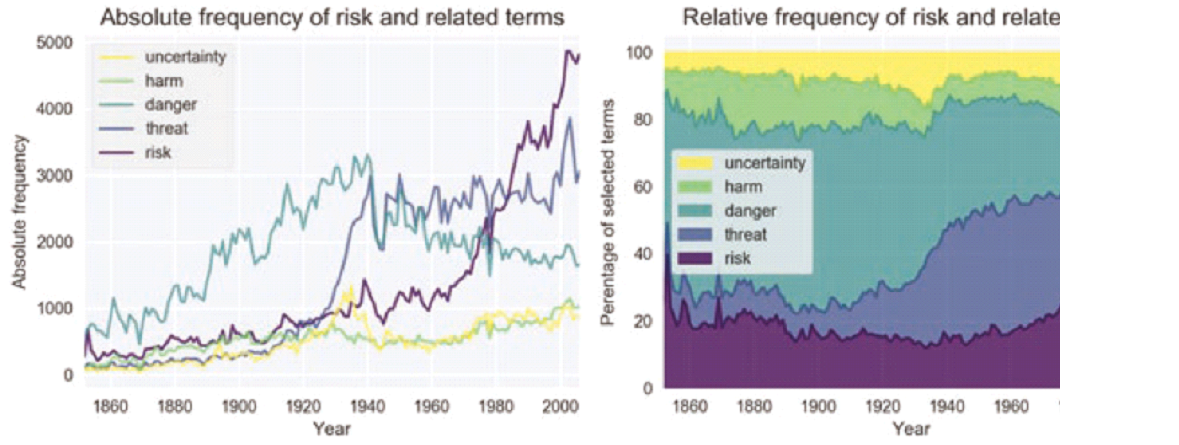
Figure 2. Number of articles in „The New York Times“ with at least one risk token, 1852 – 2008 [112]
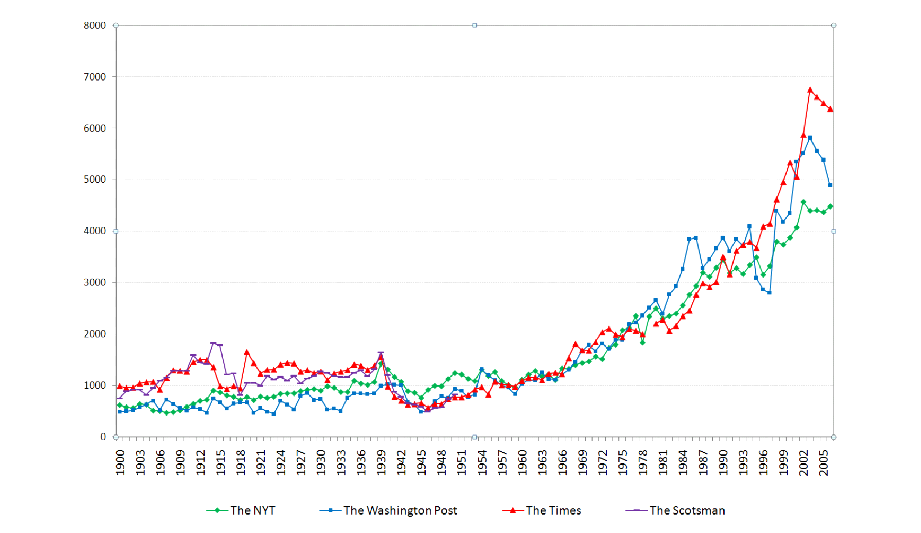
Figure 3. Number of articles where the word „risk“ is used at least once in „The New York Times“, „The Washington Post“, „The Times“, „The Scotsman“, 1900-2008 [113]
References:
1. Pianigiani, Ottorino. Vocabolario Etimologico della Lingua Italiana. Roma – Milano: Società Editrice Dante Alighieri di Albrighi & Segati, 1907, http://www.etimo.it/?term=rischio.
2. Mythen, Gabe. Ulrich Beck. A Critical Introduction to the Risk Society. London, UK: Pluto Press, 2004, р. 13.
3. Aazam, Ziad. The Two Worlds of Rizq vs. Risk: Is it an Opposition or an Opportunity for a Third Word/World?, November 18, 2011 (author's archive).
4. Cline, Preston B. The Etymology of Risk. May 20, 2004, http://citeseerx.ist.psu.edu/viewdoc/download?doi=10.1.1.112.3920&rep=re..., p. 10.
5. Wilkinson, Iain. Anxiety in a Risk Society. London, UK; New York, NY: Routledge, 2001, p. 91.
6. Merkhofer, Miley W. Decision Science and Social Risk Management. A Comparative Evaluation of Cost-Benefit Analysis, Decision Analysis, and Other Formal Decision-Aiding Approaches. Dordrecht, Netherlands: D. Reidel Publishing Company, 1987, p. I.
7. Ayto, John. Word Origins. The Hidden Histories of English Words from A to Z. London, UK: A & C Black Publishers Ltd, 2005, p. 427.
8. Merkhofer, Miley W., ibidem.
9. Walker, Russell. Winning with Risk Management. Hackensack, NJ: World Scientific Publishing Co. Pte. Ltd., 2013, р. 1.
10. Mythen, Gabe, ibidem.
11. Wilkinson, Iain, ibidem.
12. Ayto, John, ibidem.
13. Фасмер, Макс. Этимологический словарь русского языка. (онлайн версия), http://www.classes.ru/all-russian/russian-dictionary-Vasmer-term-11158.h....
Fasmer, Maks. Etimologicheskii slovar russkogo iazyka. (onlain versia), http://www.classes.ru/all-russian/russian-dictionary-Vasmer-term-11158.h.... (in Russian)
(Vasmer, Max. Etymological Dictionary of the Russian Language)
14. http://ru.wiktionary.org/wiki/%D1%80%D0%B8%D1%81%D0%BA. (in Russian)
15. Силютина, Оксана. Хозяйственный риск: понятие и научные подходы. – В: Научный журналь НИУ ИТМО, 1 марта 2011 года, 1 – 7, http://economics.open-mechanics.com/articles/313.pdf, с. 1.
Siliutina, Oksana. Hoziaistvenniy risk: poniatie i nauchniye podhody. – V: Nauchniy zhurnal NIU ITMO, 1 marta 2011 hfod, 1 – 7, http://economics.open-mechanics.com/articles/313.pdf, s. 1. (in Russian)
(Silyutina, Oksana. Economic risk: concept and scientific approaches)
16. Cline, Preston B., ibidem.
17. S & C Messina Capital Management. The Etymology of Risk, 25 February 2015, https://www.scmessina.com/2015/02/etymology-of-risk/ (author's archive).
18. Pierson, Christopher. Conversation with Anthony Giddens. Making Sense of Modernity. Cambridge, UK: Polity Press, 1998, р. 209, 105.
19. Ingles, Owen. A Linguistic Approach to Hazard, Risk and Error. – In: Handmer, John, et al. (eds.). New Perspectives on Uncertainty and Risk, Sydney: Centre for Resource and Environmental Studies, Australian National University, and Australian Counter Disaster College Natural Disasters Organisation, 1991, 66 – 78, http://cidbimena.desastres.hn/pdf/eng/doc5791/doc5791-4.pdf, p. 69.
20. Ingles, Owen, ibid., p. 68.
21. https://baike.baidu.com/item/%E9%A3%8E%E9%99%A9/2833020.
22. http://www.nihongo.aikidoka.ru/kanji_355.html.
23. Шлыкова, Елена. Анализ риска как научно-практическое направление: Историко-социологический очерк. – В: Мозговая, Алла (ред.). Социологические координаты риска. Москва: ИС РАН, 2008, 18 – 32, с. 19.
Shlykova, Elena. Analiz riska kak nauchno-prakticheskoe napravlenie: Istoriko-sociologicheskiy ocherk. – V: Mozgovaia, Alla (red.). Sociologicheskie koordinaty riska. Moskva: IS RAN, 2008, 18 – 32, s. 19. (in Russian)
(Shlykova, Elena. Risk analysis as a scientific and practical direction: Historical and sociological essay)
24. Ingles, Owen, ibidem.
25. Covello, Vincent T., Jeryl Mumpower. Risk Analysis and Risk Management: Historical Perspective. – In: Risk Analysis, 1985, Vol. 5, No. 2, 103 – 120, p. 41.
26. Molak, Vlasta. Introduction and Overview. – In: Molak, Vlasta. (ed.). Fundamentals of Risk Analysis and Risk Management. Boca Raton, FL; New York, NY; etc.: Lewis Publishers, CRC Press, Inc., 1997, 17 – 50, р. 20.
27. https://www.britannica.com/event/Rhodian-Sea-Law.
28. Ibidem.
29. De Roover, Florence Edler. Early Examples of Marine Insurance. – In: The Journal of Economic History, Nov., 1945, Vol. 5, No. 2, 172 – 200, 174 – 175.
30. De Roover, Florence Edler, ibid., р. 173.
31. Bernstein, Peter L. Against the Gods. The Remarkable Story of Risk. New York, NY; Chichester, UK; etc.: John Wiley & Sons, Inc., 1996, 1998, р. 43.
32. Damodaran, Aswath. Risk Management: A Corporate Governance Manual. SSRN Paper, September 23, 2010, http://papers.ssrn.com/sol3/papers.cfm?abstract_id=1681017, р. 35.
33. https://www.gotquestions.org/Bulgarian/Bulgarian-divine-providence.html. (in Bulgarian)
34. Bernstein, Peter L., ibid., р. 55.
35. Бехманн, Готтхард. Современное общество. Общество Риска, Информационное общество, Общество знаний. Москва: Логос, 2010, http://flibusta.site/b/529160, с. 76.
Behmann, Gotthard. Sovremennoe obshshchestvo. Obshchestvo Riska, Informacionnoe obshchestvo, Obshchestvo znanii. Moskva: Logos, 2010, http://flibusta.site/b/529160, s. 76. (in Russian)
(Behmann, Gotthard. Modern society. Risk Society, Information Society, Knowledge Society)
36. Zinn, Jens O. Introduction: The Contribution of Sociology to the Discourse on Risk and Uncertainty. – In: Zinn, Jens O. (ed.). Social Theories of Risk and Uncertainty: An Introduction. Hoboken, NJ: Blackwell Publishing Ltd., 2008, 1 – 17, p. 9.
37. Зубков, Владимир. Социологическая теория риска. Москва: Академический проект, 2009, http://www.studmed.ru/zubkov-v-sociologicheskaya-teoriya-riska_4ab8bb4d7..., 84 – 85.
Zubkov, Vladimir. Sociologicheskaia Teoria riska. Moskva: Akademicheski proekt, 2009, http://www.studmed.ru/zubkov-v-sociologicheskaya-teoriya-riska_4ab8bb4d7..., 84 – 85. (in Russian)
(Zubkov, Vladimir. Sociological risk theory)
38. Бехманн, Готтхард, ibid., 76 – 77.
(Behmann, Gotthard)
39. Bernstein, Peter L., ibidem.
40. See also: Луман, Никлас. Понятие риска. – В: Журнал Thesis, 1994, № 5, 135 – 160, http://riskprom.ru/TemaKtlg/RiskSociety/n_luman_ponjatie_riska_1991.pdf, 135 – 160.
Luman, Niklas. Poniatie riska. – V: Zhurnal Thesis, 1994, № 5, 135 – 160, http://riskprom.ru/TemaKtlg/RiskSociety/n_luman_ponjatie_riska_1991.pdf, 135 – 160. (in Russian)
(Luhmann, Niklas. Risk concept)
41. David, F. M. Games, Gods, and Gambling. New York, NY: Hafner Publishing Company, 1962, p. 26.
42. Зубков, Владимир, ibid., 81 – 83.
(Zubkov, Vladimir)
43. Rumford, Chris. Risk Society. Society and Sociology in the New Millennium. Lecture 6. Slides 3 – 24, http://www.powershow.com/view/507a5-NWVhM/RISK_SOCIETY_powerpoint_ppt_pr..., Slide 7.
44. Beck, Ulrich. World at Risk. Cambridge, UK; Malden, MA: Polity Press, 2009, p. 5.
45. Bell, Eric. Temple. Men of Mathematics. New York, NY; London, UK; etc.: Simon & Schuster, 1937, р. 73.
46. Damodaran, Aswath, ibid., р. 35.
47. Cline, Preston B., ibid., 9 – 10.
48. Hacking, Ian. The Emergence of Probability: a Philosophical Study of Early Ideas about Probability, Induction, and Statistical Inference. Cambridge, UK: Cambridge University Press, 2006, р. 12.
49. Hacking, Ian, ibid., р. 49.
50. Rechard, Rob P. Historical Relationship Between Performance Assessment for Radioactive Waste Disposal and Other Types of Risk Assessment. – In: Risk Analysis, 1999, Vol. 19, No. 5, 763 – 807, https://pdfs.semanticscholar.org/e9f2/5a4d32cb4a53979cb355ea289a36fa8ed0..., р. 767.
51. Covello, Vincent T., Jeryl Mumpower, ibid., 40 – 41.
52. Дуглас, Мэри. Риск как судебный механизм. – В: Журнал Thesis, 1994, № 5, 242 – 253, http://www.hse.ru/data/471/313/1234/5_4_2Daed.pdf, с. 243.
Duglas, Mery. Risk kak sudebniy mehanizm. – V: Zhurnal Thesis, 1994, № 5, 242 – 253, http://www.hse.ru/data/471/313/1234/5_4_2Daed.pdf, s. 243. (in Russian)
(Douglas, Mary. Risk as a judicial mechanism)
53. Bernstein, Peter L., ibid., р. 124.
54. Печенин, Николай. Концепция управляемого риска на исторических примерах. – В: Международный научный журнал Альтернативная энергетика и экология, юли 2001, т. 1, 116 – 128, http://naukarus.com/kontseptsiya-upravlyaemogo-riska-na-istoricheskih-pr..., 116 – 118.
Pechenin, Nikolay. Koncepcia upravliamogo riska na istoricheslih primerah. – V: Mezhdunarodniy nauchniy zhurnal Alternativnaia energetika i ekologia, iuli 2001, t. 1, 116 – 128, http://naukarus.com/kontseptsiya-upravlyaemogo-riska-na-istoricheskih-pr..., 116 – 118. (in Russian)
(Pechenin, Nikolay. The concept of managed risk using historical examples)
55. Bernstein, Peter L., ibid., р. 126.
56. Бернулли, Даниил. Опыт новой теории измерения жребия. – В: Вехи экономической мысли. Т. 1. Теория потребительского поведения и спроса. Санкт-Петербург: Экономическая школа, 1999, 11 – 27, http://www.seinst.ru/files/vehi11bernoulli.pdf.
Bernulli, Daniil. Opyt novio teorii izmerenia zhrebia. V: Vehi ekonomicheskoi mysli. T. 1. Teoria potrebitelskogo povedenia I sprosa. Sankt-Peterburg: Ekonomicheskaia shkola, 1999, 11 – 27, http://www.seinst.ru/files/vehi11bernoulli.pdf. (in Russian)
(Bernoulli, Daniel. An Attempt on a New Theory of the Measurement of Lots)
57. Bernoulli, Daniel. Exposition of a New Theory on the Measurement of Risk. – In: Econometrica, Jan., 1954, Vol. 22, No. 1, 23 – 36, http://citeseerx.ist.psu.edu/viewdoc/download?doi=10.1.1.436.7181&rep=re....
58. https://bg.wikipedia.org/wiki/%D0%94%D0%B0%D0%BD%D0%B8%D0%B5%D0%BB_%D0%9.... (in Bulgarian)
59. Rechard, Rob P., ibid., р. 767.
60. Bernoulli, Daniel, ibid., р. 24.
61. Bernoulli, Daniel, ibid., р. 25.
62. Bernstein, Peter L., ibid., 105 – 106.
63. http://theeconomictheory.blogspot.com/2015/08/blog-post_32.html. (in Bulgarian)
64. Rechard, Rob P., ibid., р. 767.
65. Bernstein, Peter L., ibid., р. 5, 130, 132 – 133.
66. Дуглас, Мэри, ibidem.
(Douglas, Mary)
67. Силютина, Оксана, ibid., s. 2.
(Silyutina, Oksana)
68. Hald, Anders. A History of Parametric Statistical Inference from Bernoulli to Fisher, 1713 – 1935. New York, NY: Springer, 2007, р. 34.
69. Костина, Надежда. Истоки возникновения и методические основы анализа предпринимательского риска. – В: Вестник Южно-Уральского государственного университета. Серия: Экономика и менеджмент, 2012, № 22, 147 – 151,
https://cyberleninka.ru/article/n/istoki-vozniknoveniya-i-metodicheskie-..., с. 147.
Kostina, Nadezhda. Istoki vozniknovenia i metodicheskie osnovy analiza predprinimatelskogo riska. – V: Vestnik Iuzhno-Uralskogo gosudarstvennogo universiteta. Seria: Ekonomika i menedzhment, 2012, № 22, 147 – 151,
https://cyberleninka.ru/article/n/istoki-vozniknoveniya-i-metodicheskie-..., s. 147. (in Russian)
(Kostina, Nadezhda. Origins and methodological basis for business risk analysis)
70. Костина, Надежда, ibidem.
(Kostina, Nadezhda)
71. Автономов, Владимир и др. (ред.). История экономических учений. Москва: ИНФРА-М, 2000, с. 220.
Avtonomov, Vladimir i dr. Istoria ekonomicheskih uchenii. Moskva: INFRA-M, 2000, s. 220. (in Russian)
(Avtonomov, Vladimir et al. (edt.). History of Economic Thought)
72. Marshall, Alfred. Principles of Economics. Hampshire: Palgrave Macmillan, 2013, p. 490.
73. Семенов, Виктор. Риск как связь между значительным ущербом и его предпосылками. – В: Российское предпринимательство, декабрь 2012, № 23 (221), 18 – 22, https://creativeconomy.ru/lib/7804, с. 19.
Semenov, Viktor. Risk kak sviaz mezhdu znachitelnym ushcherbom i ego predposylkami. – V: Posiyskoe predprinimatelstvo, dekabr 2012, № 23 (221), 18 – 22, https://creativeconomy.ru/lib/7804, s. 19. (in Russian)
(Semenov, Victor. Risk as a connection between significant damage and its prerequisites)
74. Дуглас, Мэри, ibidem.
(Douglas, Mary)
75. Beck, Ulrich. World Risk Society and Manufactured Uncertainties. – In: Iris, 2 October 2009, Vol. 1, No. 2, 291 – 299, p. 296.
76. Damodaran, Aswath, ibidem.
77. Wilkinson, Iain, ibid., p. 92.
78. Hacking, Ian. The Taming of Chance. Cambridge, UK: Cambridge University Press, 1990, р. 118.
79. Hacking, Ian, ibid., р. XIII.
80. Wilkinson, Iain, ibid.. p. 94.
81. Диев, Владимир. Риск и неопределенность в философии, науке, управлении. – В: Вестник Томского государственного университета, Философия. Социология. Политология, 2011, № 2 (14), 79 – 89, http://sun.tsu.ru/mminfo/000063105/phil/14/image/14-079.pdf, с. 86.
Diev, Vladimir. Risk I neopredelenost i filosofii, nauke, upravlenii. – V: Vestnik Tomskogo gosudarstvennogo universiteta, Filosoofia. Sociologia. Politologia, 2011, № 2 (14), 79 – 89, http://sun.tsu.ru/mminfo/000063105/phil/14/image/14-079.pdf, s. 86. (in Russian)
(Diev, Vladimir. Risk and uncertainty in philosophy, science, management)
82. Семенов, Виктор, ibid., с. 20.
(Semenov, Victor)
83. Hermans, Marijke A., Tessa Fox, Marjolein B. A. van Asselt. Risk Governance. – In: Roeser, Sabine, Rafaela Hillerbrand, Per Sandin, Martin Peterson. (eds.). Handbook of Risk. Theory, Epistemology, Decision Theory, Ethics, and Social Implications of Risk. New York, NY: Springer Science&Business Media B.V., 2012, 1093 – 1118, p. 1096.
84. Knight, Frank H. Risk, Uncertainty and Profit. New York, NY: Sentry Press, 1921, Reprint New York, NY: Augustus M. Kelley, Bookseller, 1964, р. 233.
85. Айзъксън, Уолтър. Айнщайн. Неговият живот и вселената. София: Жануа’98, 2009, с. 350.
Aizaksun, Uolter. Ainshtain. Negoviat zhivot i vselenata. Sofia: Zhanua’98, 2009, s. 350. (in Bulgarian)
(Isaacson, Walter. Einstein. His life and universe)
86. Rechard, Rob P., ibid., p. 773.
87. Boy, Nina. Calculating Risk and Uncertainty. Paper for King’s College Risk Research Symposium, 5 June 2009 https://cdn.cloud.prio.org/files/307ca470-a64d-4281-9876-5ae0a61c9837/Ca..., р. 5.
88. Trimpop, Rudiger M. The Psychology of Risk Taking Behavior. Amsterdam, Netherlands; London, UK; etc.: North-Holland, Elsevier Science B.V., 1994, р. 115.
89. Damodaran, Aswath, ibidem.
90. Аврамов, Йосиф, Деян Попов. Теория и история на парите и кредита. София: Сиела, 2003, с. 251.
Avramov, Iosif, Deian Popov. Teoria i istoria na parite i kredita. Sofia: |Siela, 2003, s. 251.(in Bulgarian)
(Avramov, Yosif, Deyan Popov. Theory and History of Money and Credit)
91. Концепция субъективной вероятности, http://www.riskland.ru/lib/sub_prob.shtml – author's archive.
Koncepcia subektivnoi veroiatnosti, http://www.riskland.ru/lib/sub_prob.shtml – author's archive (in Russian)
(The concept of subjective probability)
92. Седларски, Теодор, Гергана Димитрова. Основни концепции в теорията на поведенческите финанси (Basic Concepts of Behavioral Finance Theory). – В: Годишник на Софийския университет „Свети Климент Охридски“. Сопански факултет. Т. 12, 2014, https://www.researchgate.net/profile/Teodor_Sedlarski/publication/270571..., с. 197.
Sedlarski, Teodor, Gergana Dimitrova. Osnovni koncepcii v teoriata na povedencheskite finansi (Basic Concepts of Behavioral Finance Theory). – V: Godishnik na Sofiiskia universitet „Sveti Kliment Ohridski“. Stopanski fakultet. T. 12, 2014, https://www.researchgate.net/profile/Teodor_Sedlarski/publication/270571..., s. 197. (in Bulgarian)
(Sedlarski, Teodor, Gergana Dimitrova. Basic Concepts in Behavioral Finance Theory)
93. Диев, Владимир, ibid., с. 86.
(Diev, Vladimir)
94. Вяткин, Валерий, Владимир Гамза, Филипп Маевский. Риск-менеджмент. Москва: Юрайт, 2016, с. 14.
Vyatkin, Valeriy, Vladimir Gamza, Filipp Maevskiy. Risk-menedzhment. Moskva: Iurait, 2016, s. 14. (in Russian)
(Vyatkin, Valery, Vladimir Gamza, Philip Mayevsky. Risk management)
95. Bernstein, Peter L., ibid., 280 – 281.
96. Bernstein, Peter L. Capital Ideas Evolving. Hoboken, NJ: John Wiley & Sons, Inc., 2007, р. 91.
97. Йорданов, Йордан. Риск и възвращаемост II, презентация, https://www.google.com/url?sa=t&rct=j&q=&esrc=s&source=web&cd=1&ved=2ahU..., слайд 2.
Yordanov, Yordan. Risk i vuzvrashtaemost II, prezentacia, https://www.google.com/url?sa=t&rct=j&q=&esrc=s&source=web&cd=1&ved=2ahU..., слайд 2. (in Bulgarian)
(Yordanov, Jordan. Risk and Return II, Presentation)
98. Kahneman, Daniel, Amos Tversky. Prospect Theory: An Analysis of Decision under Risk. – In: Econometrica, 1979, Vol. 47, No. 2, 263 – 291.
99. Lachapelle, Eric, Faton Aliu, Enis Emini. ISO 31000:2018 Risk Management – Guidelines. White Paper, https://www.forensics.co.ug/whitepaper-iso31000/, р. 6.
100. Вяткин, Валерий, Владимир Гамза, Филипп Маевский, ibidem.
(Vyatkin, Valery, Vladimir Gamza, Philip Mayevsky)
101. Mythen, Gabe, ibidem.
102. Силютина, Оксана, ibidem.
(Silyutina, Oksana)
103. Зубков, Владимир, ibid., 84 – 85.
(Zubkov, Vladimir)
104. Зубков, Владимир, ibid., 85 – 87.
(Zubkov, Vladimir)
105. Lupton, Deborah. Risk. Key Ideas. London, UK; New York, NY: Routledge, 1999, р. 22.
106. Rumford Chris, ibid., Slide 7.
107. Bernstein, Peter L., ibid., р. 1.
108. Bernstein, Peter L., ibidem.
109. Zinn, Jens O. Risk as Discourse: Interdisciplinary Perspectives. – In: Critical Approaches to Discourse Analysis across Disciplines, 2010, Vol 4 (2), 106 – 124, http://www.lancaster.ac.uk/fass/journals/cadaad/wp-content/uploads/2015/..., р. 159.
110. Zinn, Jens O., ibid., р. 160.
111. Zinn, Jens O., ibidem.
112. Zinn, Jens O., Daniel McDonald. Risk in The New York Times (1987–2014). A Corpus-based Exploration of Sociological Theories. London, UK: Palgrave Macmillan, 2018, р. 23.
113. Zinn, Jens O. Risk as Discourse…, ibid., р. 115.
10/09/2023
Brief explanation:
The texts of my Studies have been translated into English by me. They have not been read and edited by a native English speaker, nor by a professional translator. Therefore, all errors and ambiguities caused by the quality of the translation are solely mine. But I have been guided by the thought that the purpose of these Studies is to give information about my contributions to the Science of Security by presenting them in a brief exposition, and not to demonstrate excellent English, which, unfortunately, I cannot boast of.
Strategy Synergy Security
Personal site of Prof. Dr. Nikolay Slatinski for studies and analyses in the field of national and international security


About


All content on this website is published under the conditions of Creative Commons.
You may copy and distribute the materials for non-commercial purposes freely, as long as you credit the author with a link to this page and allow other people to use them in the same way, but without changing their content.
For any other use outside of the stated conditions, you must pay a royalty to the author.